槻
Character Story & Explanation
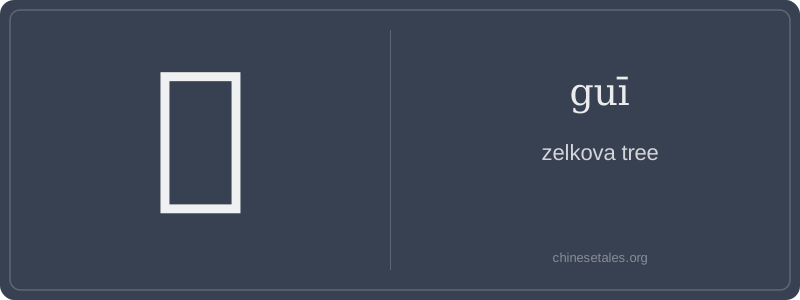
The earliest form of 槻 appears not in oracle bones — too rare for such a specific tree — but in Han dynasty bronze inscriptions and early seal script, where it fused two key elements: the 'tree' radical (木) on the left, unmistakably pictographic with its trunk and branching limbs, and the right side, 奎 (kuí), originally a pictograph of two legs striding apart (大 + 圭), later stylized to suggest stability and strength. Over centuries, the leg-like strokes of 奎 softened into angular, interlocking lines — not unlike the gnarled root flare of a mature zelkova anchoring itself against wind and time.
By the Tang dynasty, 槻 had shed its purely descriptive role and entered literary lexicons as a symbol of resilience: Du Fu once praised a scholar’s integrity by comparing his character to 槻 wood — unyielding yet gracefully grained. The visual marriage of 木 (nature) and 奎 (enduring form) became semantic destiny: this wasn’t just a tree, but *the* tree that embodies structural virtue. Even today, Japanese carpenters selecting timber for historic temple reconstruction still specify 槻 — not for size or speed of growth, but for its legendary resistance to warping across centuries of humidity and earthquake.
Think of 槻 (guī) like the 'oak' of East Asian botany — not just any tree, but a noble, hard-wooded zelkova, revered for centuries in China and Japan for temple beams, fine furniture, and even bonsai. Unlike generic words like 树 (shù, 'tree'), 槻 is hyper-specific: it names one botanical species (Zelkova serrata), much like English uses 'sycamore' or 'black walnut' — precise, poetic, and rarely used in daily speech. You won’t hear it on subway announcements or in HSK textbooks; it lives in classical poetry, forestry reports, and artisan workshops.
Grammatically, 槻 behaves like a noun — no verb forms, no adjectival usage — and almost always appears with classifiers (e.g., 一棵槻, yī kē guī) or in compound terms (e.g., 槻木, guīmù). It never stands alone as a subject in casual speech; instead, you’ll see it embedded in formal or literary contexts: 'The ancient temple’s main pillar is carved from 槻 wood.' Learners often mistakenly treat it like a common noun and try to pluralize it (e.g., *槻们) — but Chinese doesn’t pluralize nouns this way, and 槻 doesn’t even take the plural marker 们.
Culturally, 槻 carries quiet prestige: its dense, grain-rich timber symbolizes endurance and refinement — akin to how mahogany evokes colonial-era craftsmanship in English. A classic pitfall? Misreading it as 桂 (guì, osmanthus) due to similar radicals and tone — but while 桂 smells sweet and blooms in autumn, 槻 stands tall and silent, its bark deeply furrowed, its leaves turning amber before falling. This isn’t a character you ‘use’ — it’s one you recognize, respect, and occasionally whisper in a garden full of old trees.