樊
Character Story & Explanation
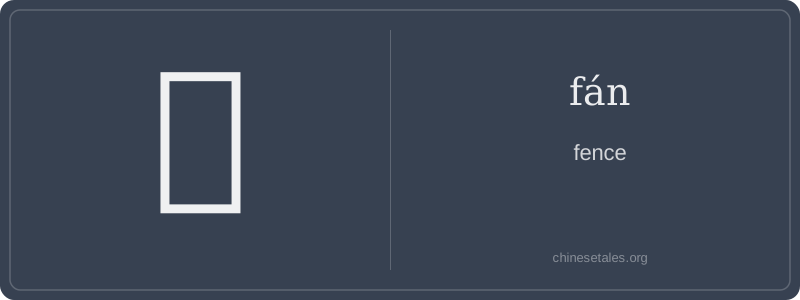
The earliest form of 樊 appears on late Shang bronze inscriptions as a pictograph showing two parallel vertical lines (representing upright wooden posts) crossed by multiple horizontal strokes — like tightly laced bamboo rods — all anchored beneath a ‘tree’ element (木). Over centuries, the top evolved into the ‘棥’ component (two 木 radicals framing a central ‘爻’-like lattice), while the bottom retained 木 as radical, emphasizing its material origin: wood-based construction. By the Han dynasty seal script, the structure stabilized: left side ‘棥’ (a doubled 木 + lattice), right side ‘木’ — visually echoing a double-walled wooden enclosure, reinforcing density and intentionality.
This visual logic shaped its semantic journey: from literal woven wooden fence in Zhou texts (like the *Book of Rites*, describing enclosures for sacrificial animals), to metaphorical ‘boundaries of propriety’ in Han Confucian commentary, then to Ming-Qing literati usage denoting intellectual or moral limits. The famous line in Tang poet Du Fu’s unfinished fragment — ‘身陷樊中不知春’ (‘Trapped inside the 樊, I forget spring has come’) — transforms the physical fence into existential confinement. Its shape literally holds the idea: two trees holding up a lattice — a prison built from nature itself.
Imagine a misty dawn in ancient Shu (modern Sichuan), where a farmer carefully weaves bamboo strips between wooden posts to build a sturdy enclosure for his goats — not just any fence, but one so dense and layered it becomes a living barrier against wolves. That’s 樊: not the flimsy garden picket of English ‘fence’, but a thick, interwoven, almost architectural boundary — evoking containment, order, and deliberate separation. In modern usage, 樊 appears almost exclusively in literary, poetic, or historical contexts (e.g., 樊籬 — ‘fence-rim’, meaning ‘boundary’ or ‘limiting constraint’), rarely in daily speech. You won’t hear ‘fán’ at the supermarket; you’ll find it in essays about ideological barriers or classical poetry lamenting being ‘trapped within the 樊籬 of ritual’. It’s a high-register, slightly melancholic word — always implying restriction, sometimes protection, never neutrality.
Grammatically, 樊 functions only as a noun and nearly always appears in compounds — never alone. It doesn’t take measure words like 个 or 条; instead, it pairs with abstract nouns like 籬, 篱, or 羅 (as in 樊籬, 樊羅) to form elegant, two-character terms. Learners often mistakenly treat it like a verb (‘to fence in’) or try using it standalone — a red flag that instantly marks non-native writing. Also, its tone is firmly fán (second tone), never fǎn or fàn — confusing it with 反 or 泛 is a classic pronunciation pitfall.
Culturally, 樊 carries quiet weight: in Confucian discourse, 樊籬 subtly critiques rigid orthodoxy — think of Zhu Xi’s commentaries warning scholars not to let doctrine become an imprisoning 樊籬. Today, journalists use it metaphorically: ‘the 樊籬 of algorithmic recommendation’ implies invisible, systemic confinement. Mistake it for a simple synonym of 围墙? You’ll miss the layered nuance — this isn’t concrete and steel; it’s woven, symbolic, and historically charged.