樕
Character Story & Explanation
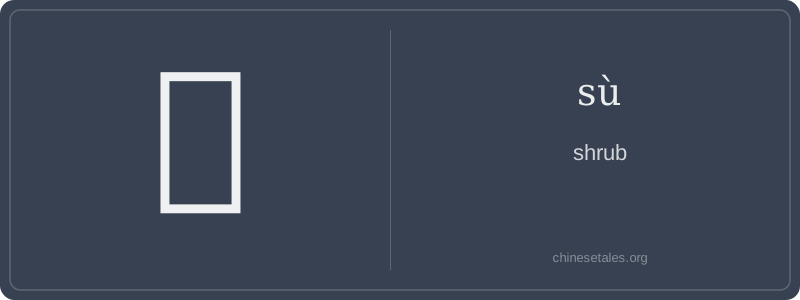
The earliest form of 樕 appears in bronze inscriptions as a stylized cluster of three or four vertical strokes beneath a simplified 'tree' radical (木), representing multiple slender stems sprouting from shared roots — like saplings pushing through leaf litter. Over centuries, the upper part condensed into the now-familiar 肅 component (itself derived from a pictograph of a ritual official with hands folded in solemnity — a visual echo of 'orderly yet dense growth'), while the lower 木 radical stayed firmly rooted. By the Han dynasty, the character stabilized into its current 16-stroke form: 肅 above, 木 below — literally 'solemn wood', capturing how shrubs grow close, compact, and quietly disciplined.
This 'solemn wood' idea resonated in early texts: in the *Erya* (c. 3rd century BCE), 樕 appears in the entry 樕棘, glossed as 'small trees with thorns, not tall but tenacious'. Later, Tang poets like Du Fu used 樕 subtly — not to name plants, but to evoke resilience in barren landscapes. The character’s visual weight (the heavy, layered 肅) mirrors its semantic role: not the hero of the forest, but its steadfast, understory anchor — a meaning preserved only because scribes kept copying ancient texts, not because people kept planting shrubs named after it.
Meet 樕 (sù) — a quiet, almost forgotten character that means 'shrub' or 'bushy plant'. It’s not flashy like 花 (huā, flower) or sturdy like 树 (shù, tree); instead, it evokes something humble, dense, and low-growing — think wild hawthorn thickets or tangled brambles along a mountain path. In classical Chinese, 樕 often appears in botanical or poetic contexts to suggest untamed, resilient vegetation — never cultivated, rarely domesticated. You won’t hear it in daily speech today; it’s a literary ghost, lingering in dictionaries and ancient herbals rather than WeChat chats.
Grammatically, 樕 functions as a noun, occasionally modified by classifiers like 丛 (cóng, 'clump') or 一株 (yī zhū, 'a plant'), but it *never* takes the common plant classifier 棵 (kē) — a subtle trap for learners. Unlike modern words such as 灌木 (guànmù, 'shrub' — the standard HSK term), 樕 stands alone, unpaired, and rarely compounds freely. Its rarity means it’s almost always found in fixed phrases or classical allusions — e.g., 樕棘 (sù jí), meaning 'thorny shrubs', used metaphorically for hardship or obscurity.
Culturally, 樕 carries a faint Daoist resonance: it symbolizes natural, unpruned growth — the opposite of imperial garden aesthetics. Learners often misread it as 素 (sù, 'elementary' or 'white') due to identical pronunciation and similar stroke density, but mixing them up turns 'a thicket of shrubs' into 'a plain, unadorned principle' — a poetic blunder with philosophical consequences! Also, don’t confuse it with 速 (sù, 'fast'); same sound, totally different world.