樘
Character Story & Explanation
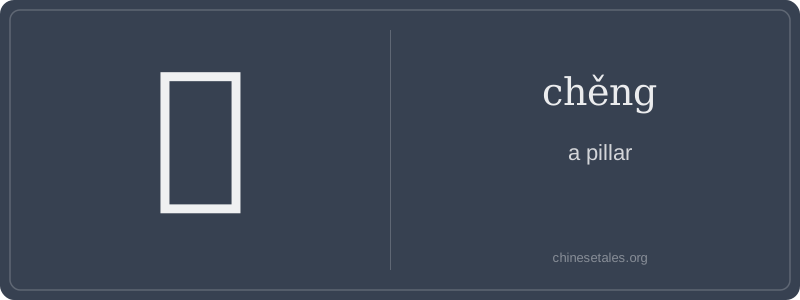
The earliest form of 樘 appears in seal script (not oracle bone), where it clearly combines 木 (wood) on the left and 尚 (shàng, 'still, yet; esteemed') on the right — not as a phonetic placeholder, but as a semantic-phonetic compound. The 木 radical signals its material origin: wooden structural elements. The right side 尚 originally depicted a tall ceremonial vessel under a roof, suggesting 'uprightness', 'elevation', and 'ritual importance' — perfectly aligning with the function of a pillar holding up sacred or residential space. Over time, strokes standardized: the top of 尚 became the familiar +八 shape, while the lower part evolved into the 小-like base seen today.
By the Han dynasty, 樘 was firmly established in architectural texts like the *Kaogong Ji* (Record of Trades) to denote load-bearing posts in palace and temple construction. In Tang poetry, it appears metaphorically — Du Fu once wrote of 'broken 樘' to evoke fallen dynastic order. Visually, the character itself stands tall: 15 strokes arranged with vertical emphasis — the long central stroke of 尚 mirroring the pillar it names. Its balance — wood grounded, aspiration elevated — makes it a silent manifesto of classical Chinese spatial philosophy.
At first glance, 樘 (chěng) feels like a quiet, architectural word — it means 'a pillar' or 'a structural post', but not the grand, freestanding kind you’d see in a temple hall. Instead, it’s the humble, load-bearing vertical element *inside* traditional timber-frame buildings: the uprights that hold up beams, support roof structures, and define bay spaces. To Chinese speakers, this character evokes craftsmanship, stability, and hidden strength — values deeply embedded in classical architecture and Confucian metaphors for moral uprightness ('a pillar of society'). It’s not abstract; it’s tactile, carpenter-level precise.
Grammatically, 樘 is almost exclusively a measure word — but not for generic objects. It’s used *only* for pillars, posts, or sometimes door/window frames in classical or literary contexts (e.g., 一樘门 — 'one door frame'). You’ll never say *three 樘 chairs* — that’s a classic learner error. It’s also rarely used alone as a noun; instead, it appears in compounds like 门樘 or 窗樘. Its usage is highly constrained, making it a 'precision tool' in the lexicon — elegant, functional, and context-bound.
Culturally, 樘 reveals how Chinese language encodes embodied knowledge: the same character that names a physical post also subtly carries the idea of 'structural integrity' in rhetoric or ethics. Learners often mispronounce it as *táng*, confusing it with 堂 (hall), but the correct literary reading is chěng — a subtle reminder that tone isn’t just musical, it’s semantic scaffolding. Also, don’t mix it up with 棟 (dòng, 'ridgepole') — 樘 is vertical support; 棟 is horizontal crown.