枢
Character Story & Explanation
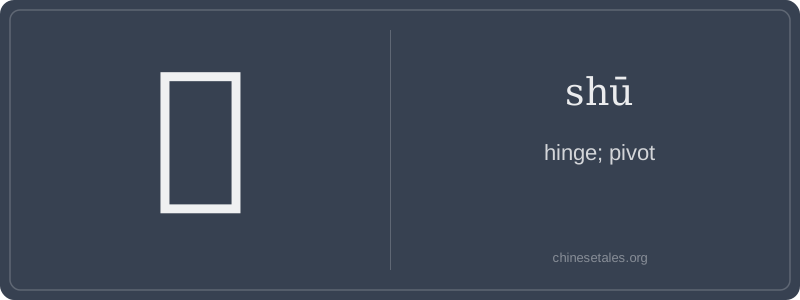
The earliest form of 枢 appears in bronze inscriptions as a stylized wooden post with a circular joint — imagine a vertical beam (木) pierced by a horizontal axle (区, then written with curves suggesting rotation). The left side 木 (mù, 'tree/wood') anchors it in the material world: doors, gates, and pillars were all made of wood in ancient China. The right side 区 (qū) wasn’t originally about 'area'; its oracle bone form resembled a coiled rope encircling a space — symbolizing containment and controlled turning. Over centuries, the coil simplified into the modern 区, while the wood radical stayed firm, preserving the idea of a *wooden axis enabling precise, contained motion*.
This visual logic shaped its meaning: from a physical door pivot in Zhou dynasty architecture to a metaphor for any essential, stabilizing center. Mencius (3rd c. BCE) used 枢 implicitly when describing righteous conduct as the 'unmoving hinge' of moral action — stable, silent, yet enabling all virtuous movement. Later, in military treatises like the Wǔjīng Zǒngyào, 枢 described command centers where intelligence flowed and decisions turned the tide. Its shape — wood + enclosure — still whispers: 'This is where things revolve, but the core holds.'
Think of 枢 (shū) as the 'doorknob of destiny' — not just a hinge, but the invisible pivot point where power, influence, or change turns. In Chinese, it’s never used for literal door hinges (that’s 铰 jiǎo); instead, it’s reserved for abstract, high-stakes pivots: the central node of a network, the decisive factor in strategy, or the core institution holding a system together. It carries weight and authority — like calling Washington D.C. the 'political hinge' of the U.S., but with Confucian gravity.
Grammatically, 枢 almost always appears in compounds (never standalone), usually as the second character, and frequently modifies nouns denoting systems or structures: 决策枢纽 (jué cè shū niǔ, 'decision-making hub'), 交通枢杻 (jiāo tōng shū niǔ, 'transportation hub'). Learners sometimes misplace it as a verb ('to pivot') — but it’s strictly a noun or attributive noun; you’d say 枢纽地位 (shū niǔ dì wèi, 'pivotal status'), not *枢了. Also, it’s tone-2 (shū), not shù — confusing it with 漱 (shù, 'to rinse') is a classic slip that could turn your 'strategic center' into 'a mouthwash station'.
Culturally, 枢 evokes classical cosmology: in ancient texts like the Huáinánzǐ, the North Star was called 北辰为枢 (běi chén wéi shū), 'the North Star serves as the cosmic pivot' — everything rotates around it, yet it remains still. Modern usage preserves this quiet centrality: a tech startup isn’t 'a pivot'; it’s *at* the pivot. Mistake this character for something casual, and you’ll sound either hilariously overblown or dangerously naive.