樴
Character Story & Explanation
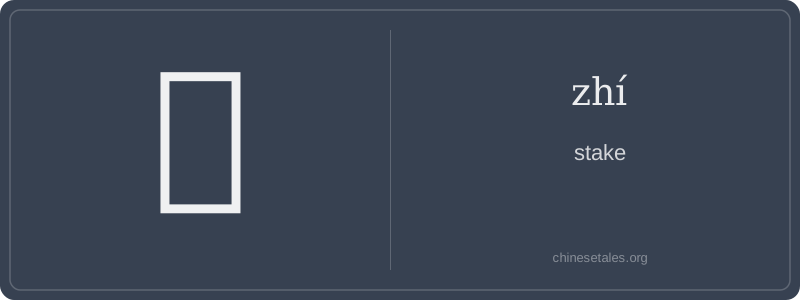
The earliest form of 樴 appears in bronze inscriptions (not oracle bone), where it was written with a clear pictographic core: a vertical line (丨) representing the stake itself, embedded in a simplified ‘earth’ base (土), and crowned by a ‘tree/wood’ element (木) — showing literally *wood driven into earth*. Over time, the ‘earth’ base evolved into the bottom component of today’s character, while the ‘wood’ radical 木 shifted leftward to become the official radical. The central vertical stroke remained stubbornly upright — a visual echo of the stake’s purpose: unwavering insertion.
By the Han dynasty, 樴 was already used in legal and agrarian contexts to denote property markers — stakes literally defining ownership. The Shuōwén Jiězì (c. 100 CE) defines it as ‘a wooden post set in ground to mark territory or secure something’. Its meaning never drifted into abstraction; unlike 柱 (pillar), which gained metaphorical uses like ‘pillar of society’, 樴 stayed rooted — both semantically and etymologically — in soil, labor, and tangible boundaries. Even in Du Fu’s poems, when he writes of ‘broken stakes’ in abandoned fields, the image is visceral, tactile, and deeply agricultural.
Think of 樴 (zhí) not as a fancy word, but as a humble, sturdy *stake* — the kind you’d hammer into earth to hold a fence, tether a horse, or mark a boundary. It carries a grounded, functional energy: solid, vertical, unyielding. In classical and literary Chinese, it’s rarely used alone in modern speech, but appears with quiet authority in compound words like 桩樴 (zhuāng zhí) — 'stakes and piles' — evoking construction, anchoring, or even legal claims on land. You won’t hear it in café small talk, but you *will* see it in historical texts, agricultural records, or poetic metaphors for steadfastness.
Grammatically, 樴 is a noun — almost always countable and concrete — and nearly never functions as a verb or adjective. Learners sometimes mistakenly treat it like the more common 柱 (zhù, 'pillar'), but 樴 is shorter, earth-bound, and implies *insertion into soil*, not architectural support. It also never appears in HSK vocabulary, so don’t expect flashcards or listening drills — this is a character you’ll encounter while reading Tang dynasty poetry or Ming-era land deeds, not beginner textbooks.
Culturally, stakes symbolize demarcation, commitment, and permanence — think of ancient boundary markers or ritual poles planted before ceremonies. A common mistake? Confusing 樴 with 木 (mù, 'wood') or 立 (lì, 'to stand') because of its shape — but 樴 is *specifically* a wooden stake *driven in*, not just wood or standing. Its rarity makes it a delightful ‘easter egg’ for advanced learners: spotting it feels like finding an old bronze nail still holding a temple beam together.