橃
Character Story & Explanation
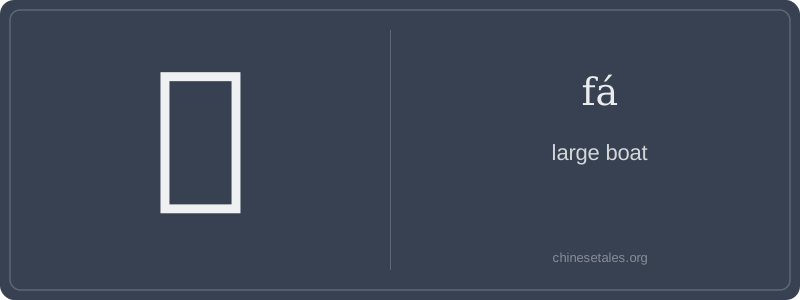
The earliest form of 橃 appears in Warring States bamboo slips (c. 475–221 BCE), not oracle bones — it’s too late for that era. Its bronze script ancestor shows a clear ‘wood’ (木) base with a stylized ‘father’ (父) above a horizontal line representing water or deck level. Over centuries, the ‘father’ component simplified: the top dot became a short stroke, the two downward strokes thickened into the modern ‘fù’ shape, and the wood radical solidified into its standard left-side form. Crucially, the right side was never meant to mean ‘father’ — it was purely phonetic scaffolding, though scribes later associated the authoritative tone of ‘father’ with the commanding presence of such vessels.
By the Han dynasty, 橃 denoted official transport craft capable of carrying 100+ tons — mentioned in the Records of the Grand Historian describing Emperor Wu’s southern campaigns. In Li Bai’s poetry, 橃 glides past mist-shrouded cliffs, symbolizing both journey and imperial reach. Its visual weight — the dense, grounded wood radical anchoring the elevated ‘father’ — mirrors how these boats were literal foundations of empire: stable, strong, and socially elevated above mere rafts or fishing skiffs.
Let’s unpack 橃 (fá) like a linguist opening a time capsule: it’s not just ‘large boat’ — it’s a vessel steeped in ancient riverine logistics and imperial ambition. The character is composed of the wood radical (木) on the left — signaling material origin (wooden construction) — and the phonetic component 父 (fù, ‘father’) on the right, which here serves primarily to hint at pronunciation (fá is a close tonal variant of fù). This isn’t a casual word for ‘boat’; 橃 evokes massive, oar-powered transport ships used in pre-Tang dynastic supply chains — think grain barges on the Grand Canal or warships carrying thousands of troops down the Yangtze.
Grammatically, 橃 is almost exclusively literary or historical. You won’t hear it in daily speech or modern news; it appears in classical poetry, historical texts, or formal prose describing antiquity. It functions as a noun only — never a verb or adjective — and rarely takes modifiers like ‘big’ or ‘old’ because its meaning already implies monumental scale. Learners sometimes mistakenly use it where 船 (chuán) or 轮船 (lúnchuán) would be natural — but that’s like saying ‘galleon’ when you mean ‘ferry’. It’s context-sensitive and prestige-loaded.
Culturally, 橃 carries quiet authority: in the Book of Songs and Tang stele inscriptions, it signals state power, logistical mastery, and human command over waterways. A common learner trap? Confusing it with 筏 (fá, ‘raft’) — same pinyin, totally different structure and connotation (a raft is humble, improvised; 橃 is engineered, hierarchical). Also, don’t expect stroke count help — its 16 strokes hide behind elegant symmetry, making it deceptively complex to write.