桡
Character Story & Explanation
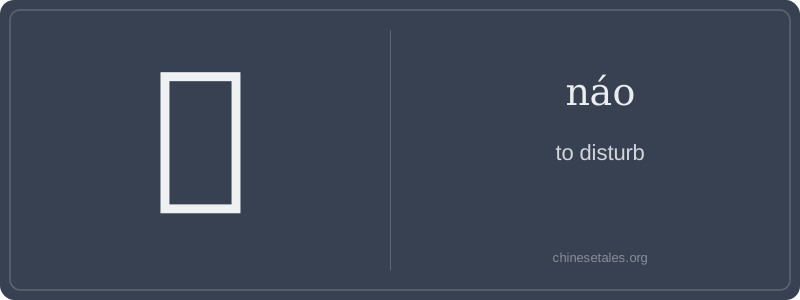
Oracle bone and bronze inscriptions show no direct precursor for 桡 — it emerged later, during the Warring States period, as a phono-semantic compound. Visually, it fuses 木 (mù, 'tree/wood') on the left — serving purely as a phonetic hint (both 木 and 桡 once shared related ancient pronunciations) — and 右 (yòu, 'right') on the right, which evolved into today’s simplified top-right component (爫 + 丿 + 一 + 丶). But don’t be fooled: 右 wasn’t chosen for 'direction'; its shape was borrowed for its sound value *nǎo* in ancient dialects. Over centuries, 右’s strokes softened, its horizontal lines thickened, and the dot settled firmly — yielding the crisp, ten-stroke 桡 we write today.
The meaning grew from concrete to cosmic: early uses described physical interference — like a branch snagging a boat’s oar (hence the folk etymology linking it to 'oar' — though unrelated to the modern word 桨). By the Han dynasty, it had abstracted into 'to impede principle' or 'to corrupt purity', appearing in texts like the *Huainanzi* warning against '桡德' (náo dé, 'disturbing virtue'). Its visual duality — wood (stability) crossed by a 'right'-shaped element (suggesting deviation) — perfectly mirrors its semantic tension: order unsettled, clarity clouded, intention deflected.
At first glance, 桡 (náo) feels like a quiet intruder — not the flashy 'disturb' of shouting or smashing, but the subtle, persistent kind: a pebble tossed into still water, a whispered doubt in a confident plan. Its core meaning is 'to disturb, disrupt, or interfere', often with an undertone of unwelcome or untimely intervention — think disrupting harmony, muddying clarity, or derailing intention. It’s literary and formal, rarely heard in casual speech; you’ll meet it in classical texts, philosophical essays, or modern writing aiming for elegance or gravity.
Grammatically, 桡 functions almost exclusively as a verb, usually transitive and often paired with abstract nouns: 桡乱 (náo luàn, 'to disrupt order'), 桡人清梦 (náo rén qīng mèng, 'to disturb someone’s peaceful dream'). It never stands alone — no 'I 桡' — and never takes aspect particles like 了 or 过 directly; instead, it appears in tightly packed compound verbs or passive-like constructions (e.g., ‘计划被桡’ is rare; better: ‘计划遭到桡扰’). Learners often misread it as ráo (like 饶), but that pronunciation belongs to a different character entirely — here, náo is non-negotiable.
Culturally, 桡 carries a faint Confucian echo: disturbance isn’t neutral — it implies violation of natural or moral equilibrium. Mistake it for 挠 (náo, 'to scratch') and you’ll accidentally say 'I scratch the social order' instead of 'I disturb it' — same sound, wildly different imagery. And while both share the 木 radical, 桡’s 'wood' isn’t about material — it’s a phonetic anchor, not a semantic one. That wooden root? A red herring. The real action is all in the top half: the 'nao' sound and the sense of something slipping sideways, off-balance.