橐
Character Story & Explanation
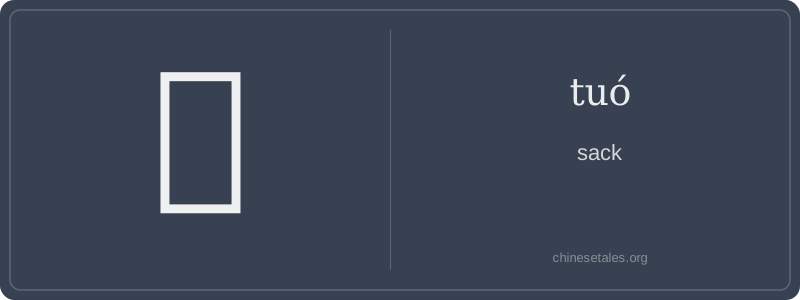
The earliest form of 橐—found on Warring States bamboo slips—was a vivid pictograph: two parallel vertical lines (representing the open mouth of a sack), flanked by curved strokes suggesting folded leather or cloth, with a horizontal bar across the top sealing it shut. Over centuries, the top seal became the radical 木 (wood), likely because early sacks were reinforced with wooden hoops or frames—or perhaps due to phonetic borrowing (the ancient pronunciation of 木 and 橐 were closer). The lower part evolved from 口 (mouth/sack opening) into 亇 + 一 + 口, stylized into today’s complex bottom half—16 strokes that still whisper 'tightly bound vessel'.
By the Han dynasty, 橐 had solidified its dual identity: literal (a felt or hide sack for transport) and metaphysical (in the *Daodejing*, chapter 5, 橐籥 describes the universe as an empty bellows—hollow yet infinitely generative). This duality made it indispensable in classical rhetoric: to say someone ‘holds no 橐’ wasn’t about luggage—it meant they carried no hidden agenda, no concealed power. Even today, when writers use 橐 in essays on governance or ecology, they’re invoking that ancient image of contained potential waiting to be drawn forth.
Think of 橐 (tuó) not as a generic 'bag' but as a heavy, sturdy, animal-skin sack—specifically the kind strapped across a camel’s back on ancient Silk Road caravans. Its core meaning is deeply tactile: coarse, durable, portable storage for grain, charcoal, or tools—not the flimsy plastic bag you’d get at a supermarket. The character radiates earthy pragmatism, evoking dusty trade routes and pre-industrial logistics.
Grammatically, 橐 is almost never used alone in modern speech—it’s a literary or classical word, so you’ll rarely hear it in conversation or HSK texts. Instead, it appears in fixed compounds (like 橐駞 or 橐籥) or poetic descriptions where weight, tradition, or antiquity matters. Using it solo—e.g., saying '我有一个橐'—would sound like quoting a Tang dynasty poem at a coffee shop: technically correct, wildly out of place. Learners often overestimate its frequency because it appears in dictionaries; in reality, it’s a fossilized term preserved in idioms and historical texts.
Culturally, 橐 carries quiet authority: it’s the sack that carried Han dynasty tax grain, the bellows-sack in Daoist cosmology (where 橐籥 symbolizes the universe’s rhythmic breath), and even appears in Sun Tzu’s *Art of War* as metaphor for concealed resources. A common mistake? Confusing it with more common 'bag' words like 包 (bāo) or 袋 (dài)—but 橐 isn’t about convenience; it’s about endurance, concealment, and silent capacity.