橚
Character Story & Explanation
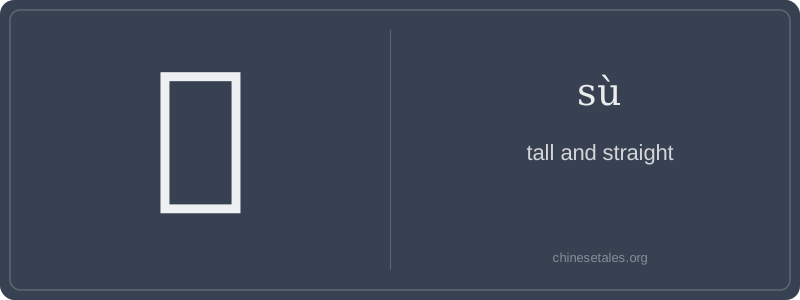
The earliest form of 橚 appears on Warring States bamboo slips — not oracle bones, but elegant ink strokes on fragile strips. Visually, it combines the wood radical (木) on the left with a phonetic component 叔 (shū) on the right, which originally depicted a hand grasping a stalk of grain. Over centuries, 叔 simplified: its top stroke flattened, the 'hand' (又) fused into a dot-and-hook, and the grain stalk became the distinctive three horizontal strokes at the bottom — subtly echoing layers of treetop branches reaching skyward.
This evolution wasn’t accidental: the character was crafted to evoke *wood standing firm*. By the Han dynasty, 橚 appeared in the Shuōwén Jiězì dictionary defined as 'tall and straight like a tree', cementing its link between botanical stature and human virtue. Poets like Tao Yuanming used 橚 in lines describing solitary pines on cliffs — not merely tall, but *unbowed*. Even today, calligraphers love writing 橚 because its balanced left-right structure and clean vertical lines visually enact its meaning: every stroke leans neither left nor right, but rises with quiet authority.
Let’s be honest: 橚 (sù) is a quiet legend — it doesn’t shout, but it stands tall and unshakable. Its core meaning isn’t just ‘tall’ in the physical sense; it’s about vertical integrity — think of a pine tree in winter, a scholar holding fast to principle, or a pagoda rising with quiet dignity. In Classical Chinese, 橚 evokes moral uprightness as much as height: it’s the kind of ‘straight’ that implies incorruptibility, not just geometry.
Grammatically, 橚 is almost exclusively literary and adjectival — you’ll rarely hear it in speech or modern textbooks. It appears mainly in poetic compounds (e.g., 橚然, 橚立) or as a modifier before nouns (e.g., 橚松 — 'towering pine'). Crucially, it *never* functions as a verb or takes aspect markers like 了 or 过 — a common learner mistake is trying to say 'he became tall' with 橚, but that’s not how it works. It describes an inherent, serene, unchanging verticality.
Culturally, 橚 reveals how deeply Chinese aesthetics tie physical form to virtue: height without bending = moral fortitude. Confucian texts praise rulers who govern with 橚然之德 ('towering, upright virtue'), and Daoist poetry uses 橚 to describe mountains that embody stillness-in-ascent. Learners often misread it as 肃 (sù, 'solemn') due to identical pronunciation — but while 肃 chills the air, 橚 lifts the gaze. Its rarity today makes it a subtle marker of refined literary taste, not everyday fluency.