檐
Character Story & Explanation
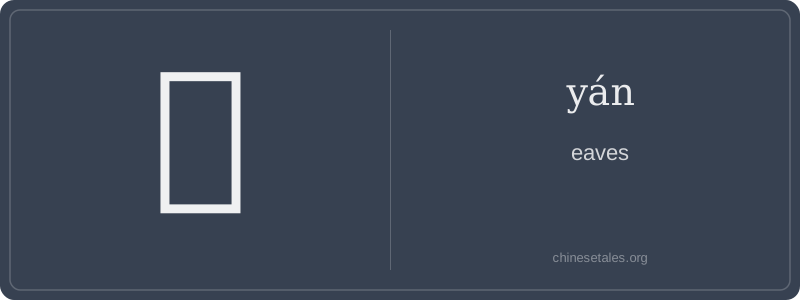
The earliest form of 檐 appears in seal script (around 200 BCE), where it clearly shows a house roof (宀 mián) hovering over a tree-like shape — but that ‘tree’ is actually the 木 (mù, 'wood') radical, emphasizing the *timber structure* supporting the overhang. The right side, 丿 + 日 + 彐 + 一, evolved from the ancient phonetic component 奄 (yǎn), which also carried meaning: 'to cover' or 'to shelter'. Over centuries, the top 宀 softened into the modern 豕-like curve, and the lower part condensed into the elegant 4-stroke 'yàn' ending — preserving both wood's role and the sheltering function.
By the Tang dynasty, 檐 had become indispensable in poetry — Li Bai wrote of '檐角风铃' (yán jiǎo fēng líng, wind bells at eave corners), evoking sound, motion, and quiet reverence. Its visual design mirrors its meaning perfectly: the left 木 says 'made of wood'; the right side, echoing 奄 ('to cover'), whispers 'this part *shields*'. Even today, when you see a curved Song-dynasty eave soaring above a temple, you’re seeing the character 檐 made three-dimensional — architecture and writing breathing the same air.
Think of 檐 (yán) not as just 'eaves' — the overhanging edge of a roof — but as architecture’s quiet guardian: it shelters, directs rain, and frames the sky like a wooden eyebrow over a building’s face. In Chinese, it’s almost always noun-only, appearing in descriptive, poetic, or architectural contexts — never as a verb or adjective. You’ll rarely hear it in daily chit-chat ('What’s for lunch?'), but you’ll see it shimmering in classical poetry, temple descriptions, or when someone points to the dripping edge of an old courtyard roof: '看那飞檐!' (kàn nà fēi yán! — 'Look at those upturned eaves!').
Grammatically, it loves compound nouns and rarely stands alone. It’s often modified by measure words like 座 (zuò) for large structures ('一座屋檐') or paired with verbs like 滴 (dī, 'to drip') or 飞 (fēi, 'to soar') — because traditional Chinese eaves don’t just hang; they *leap* upward at the corners. Learners sometimes misread it as 'roof' (屋顶 wūdǐng), but 檐 is specifically the *projecting rim*, not the whole covering — like distinguishing 'brim' from 'hat'.
Culturally, 檐 carries weight beyond carpentry: in imperial architecture, eave length signaled rank (longer = higher status), and carved eave brackets (斗拱 dǒugǒng) were engineering marvels that held up entire roofs without nails. A common mistake? Confusing it with 岩 (yán, 'rock') — same sound, totally different world. Remember: 木 (wood) radical = built, not born from mountain.