槚
Character Story & Explanation
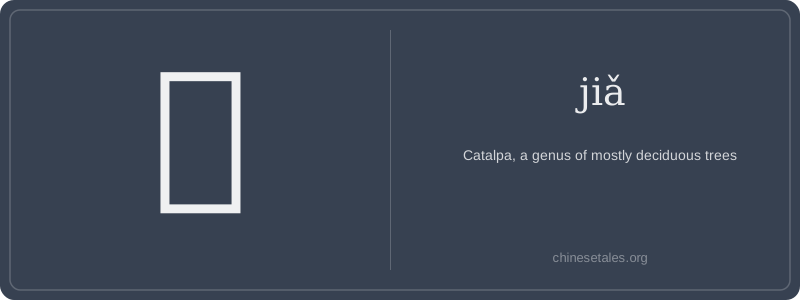
The earliest attested form of 槚 appears in Han dynasty clerical script, evolving from a bronze inscription compound: the left side 木 (mù, 'tree') anchors the meaning, while the right side 賈 (gǔ/jiǎ) originally depicted a merchant weighing goods under a roof—symbolizing exchange and value. Over centuries, 賈 simplified visually into the modern 賈-like component (with radical 210, 貝), retaining its phonetic role: 'jiǎ'. Crucially, the top stroke of the right-hand component was never a 'grass' radical—it’s a stylized roof (宀) fused with 貝, making 槚 a rare example of a tree name borrowed from a commercial term, perhaps hinting at the tree’s historical value as timber traded by merchants.
This semantic twist deepened over time: in the *Bencao Gangmu* (1596), Li Shizhen notes 槚 wood’s resistance to rot and use in coffin-making—linking its durability to moral steadfastness. By the Ming dynasty, poets used 槚 metonymically: 'jiǎ yīn' (catalpa shade) evoked scholarly seclusion, much like 'pine wind' or 'bamboo rain'. Its visual structure—wood + valued commodity—thus silently reinforces a core Confucian idea: true worth grows slowly, rooted in nature yet recognized by discerning culture.
Imagine walking through an ancient temple courtyard in Sichuan, where a towering catalpa tree—its broad leaves rustling and white-tinged purple flowers drifting down like tiny bells—shades a weathered stone stele. A local scholar points to the carved character 槚 on the stele’s base and says, 'Zhè shì jiǎ, bù shì jiā.' That soft, breathy 'jiǎ' (not the more common 'jiā') is your first clue: this character names not just any tree, but the catalpa—a graceful, culturally resonant deciduous tree long associated with scholarly virtue and quiet resilience in classical Chinese gardens and poetry.
Grammatically, 槚 functions almost exclusively as a noun, usually embedded in botanical or literary contexts—not in daily speech. You’ll rarely hear it alone; instead, it appears in compounds like 楸槚 (qiū jiǎ) or in classical allusions. Learners often misread it as jiā (like 家) due to the shared 'jia' sound family—but no tone mark or context saves you here: 槚 is always fourth tone, and its presence signals deliberate, refined diction. It doesn’t take measure words casually; you wouldn’t say 'yī kē jiǎ' without sounding like a botany textbook come to life.
Culturally, 槚 carries subtle prestige—it’s the kind of word that appears in Song dynasty garden manuals or Qing-era poetry describing ideal scholarly retreats. Modern Mandarin speakers may recognize it only from botanical texts or calligraphy scrolls. A common mistake? Assuming it’s interchangeable with other tree characters like 桐 (tóng, paulownia) or 楸 (qiū, catalpa’s close relative)—but 槚 specifically denotes *Catalpa ovata*, prized for its durable, fine-grained timber and symbolic association with integrity and endurance.