樯
Character Story & Explanation
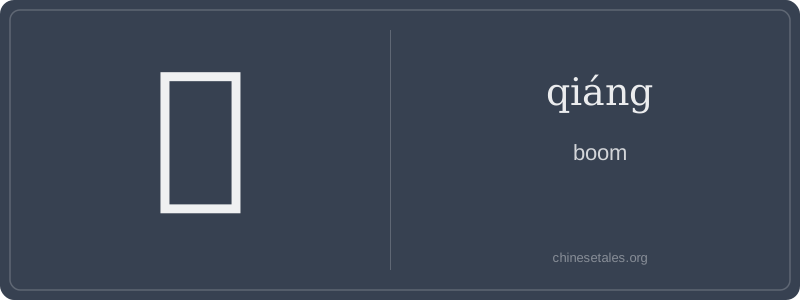
The earliest form of 樯 appears in Han dynasty bamboo slips — not oracle bones, since it’s a relatively late compound character. Its left side is 木 (mù), the ‘tree/wood’ radical, unmistakably signaling its material origin. The right side is 墙 (qiáng, ‘wall’), borrowed *only for sound*, not meaning — a classic phono-semantic compound. Stroke by stroke: first the wood radical (4 strokes), then the wall component (11 strokes), totaling 15. Visually, it’s a vertical timber (木) braced against a sturdy, layered structure (墙), mirroring how a boom is anchored firmly to a mast and rigged with ropes.
Its meaning crystallized during the Han–Tang maritime boom: early texts like the Book of the Later Han mention ‘樯橹’ (qiáng lǔ) — ‘booms and oars’ — as metonyms for warships. By the Song dynasty, poets used 樯 metaphorically: broken booms signaled fallen dynasties; tall, upright booms stood for resilience. Crucially, the character never meant ‘mast’ (that’s 桅 wéi) — the boom is *horizontal*, the mast *vertical*. This spatial distinction is baked into its etymology: wood + wall-sound, evoking something rigid, extended, and structural — like a wall stretched across the sky.
Imagine standing on the deck of a Tang dynasty junk during a typhoon — rain lashes sideways, waves crash like thunder, and the massive wooden boom (qiáng) groans as it pivots the sail. That’s 樯: not just any pole, but the *critical, load-bearing horizontal spar* that extends from a ship’s mast to hold the sail taut. In Chinese, it carries weight, tension, and nautical authority — never used for modern cranes or flagpoles (those are 吊臂 or 旗杆). It’s a literary, almost poetic word: you’ll find it in classical poetry, historical novels, or maritime museums — not in daily conversation.
Grammatically, 樯 is almost always a noun and appears in compounds (like 桅樯 or 风樯) or descriptive phrases. You won’t say ‘I saw a 樯’ alone; instead, it’s ‘风樯林立’ (fēng qiáng lín lì) — ‘wind-filled booms stand in dense rows’, evoking a bustling ancient harbor. Learners sometimes misread it as ‘wall’ (qiáng 墙) because of the shared pinyin — but 樯 has wood (木) on the left, not earth (土); confusing them turns a sailing image into a brickyard!
Culturally, 樯 embodies China’s deep, often overlooked maritime heritage — far beyond the Silk Road. In Su Shi’s poetry, ‘断樯’ (duàn qiáng, broken boom) symbolizes shattered ambition after exile. Modern usage is rare but precise: naval historians, classical translators, and calligraphers use it reverently. Don’t force it into beginner sentences — wait until you’re describing a painting of Zheng He’s fleet or quoting Li Bai.