檫
Character Story & Explanation
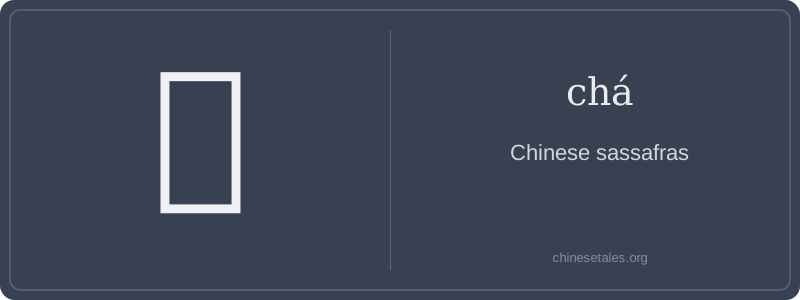
The earliest form of 檫 appears not in oracle bones but in later seal script (around 3rd century BCE), where it already combines the 木 (mù, ‘tree’) radical on the left with the right-hand component 察 (chá, ‘to inspect’). That right side wasn’t arbitrary: 察 itself evolved from a pictograph showing an eye (目) under a roof (宀), symbolizing careful observation — fitting for a tree whose distinctive bark and leaf shapes helped herbalists identify it in dense forests. Over centuries, the strokes streamlined: the top of 察 simplified from 炎-like complexity to today’s three horizontal lines above 夂, while 木 retained its classic ‘tree’ shape — two branches, a trunk, and roots implied.
By the Tang dynasty, 檫 was documented in herbal manuals like *Xinxiu Bencao*, praised for its fragrant wood used in coffins and temple beams — believed to repel insects and decay. The character’s visual duality reflects this: 木 grounds it in botany, while 察 hints at human discernment — you don’t just see a 檫 tree; you *recognize* it, distinguishing it from lookalikes like camphor or cinnamon. Its literary footprint is slim but resonant: in Ming-era travelogues, writers described ‘chá shù yīn yīn’ (the dense shade of sassafras) along Fujian mountain paths — a subtle marker of untouched terrain.
Think of 檫 (chá) as China’s answer to the American sassafras tree — not just a botanical cousin, but a cultural echo: both were once prized for aromatic bark, medicinal teas, and even early root beer flavors. In Chinese, 檫 isn’t a daily-use word like ‘tree’ or ‘wood’; it’s a quiet specialist — appearing mostly in botanical texts, regional forestry reports, or poetic descriptions of southern forests. You’ll almost never hear it in casual speech, which is why learners often overestimate its frequency (or miss it entirely). It’s strictly a noun — no verbs, no adjectives — and always refers to the specific deciduous tree *Sassafras tzumu*, native to China’s Yangtze basin.
Grammatically, 檫 behaves like other plant-name nouns: it pairs with classifiers like 株 (zhū, for individual trees) or 林 (lín, for groves), and rarely stands alone. You won’t say ‘I 檫-ed the table’ — it doesn’t verbify. A common mistake? Confusing it with similar-sounding chá characters like 查 (investigate) or 茶 (tea), especially when listening. But here’s the kicker: 檫 is tone 2 (chá), same as 茶 — yet while 茶 fills teahouses, 檫 grows silently in misty mountains, unboiled and unserved.
Culturally, 檫 carries quiet ecological weight: it’s a ‘relict species’, surviving since the Tertiary period — older than most human languages. Modern conservation efforts highlight it as an indicator of healthy subtropical forests. Learners sometimes try to force it into compound words (e.g., *shān chá*), but that’s incorrect — 檫 never means ‘mountain tea’. Its true compounds are narrow and technical: 檫木 (chá mù), 檫树 (chá shù), 檫林 (chá lín). Respect its specificity — it’s not a metaphor, it’s a living fossil.