檵
Character Story & Explanation
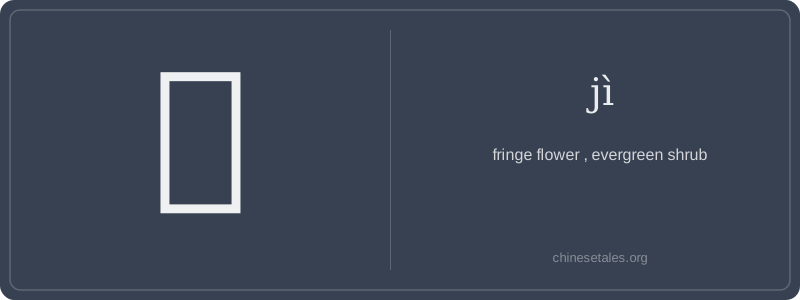
The earliest trace of 檵 isn’t in oracle bones — it’s too late for that — but in Song dynasty lexicographical works like the Jiyun (1037 CE), where it first appears as a carefully constructed phono-semantic compound. Visually, it merges 木 (mù, ‘tree/wood’, radical) on the left — anchoring it firmly in the plant kingdom — with 祭 (jì, ‘ritual offering’) on the right, which provides both pronunciation and an unexpected layer of resonance: in classical usage, certain sacred groves were tended with ritual care, and the fringe flower’s elegant, almost ceremonial blooms may have evoked such reverence. Over centuries, the right side simplified from full 祭 (12 strokes) to its modern form — preserving the core phonetic cue while streamlining the script.
Historically, 檵 never entered mainstream literary canon like 桃 (peach) or 松 (pine), but it appears in Ming-Qing herbal manuals and regional gazetteers describing southern Chinese flora — especially Hunan and Guangdong, where the plant thrives. Its visual duality is striking: the dense, intricate right side (with its repeated horizontal strokes and compact ‘G’-like top) mirrors the shrub’s dense foliage and cascading floral threads. Even today, botanists in Taiwan and Fujian prefer 檵木 over generic terms — honoring continuity from classical nomenclature to modern taxonomy.
Meet 檵 (jì) — a botanical deep-cut, not a daily conversational player. It’s a rare, elegant character naming a specific evergreen shrub: the fringe flower (Loropetalum chinense), known for its delicate, thread-like petals and glossy leaves. In Chinese, it functions almost exclusively as a noun — never a verb or adjective — and appears almost solely in botanical texts, regional floras, or poetic nature descriptions. You won’t hear it in markets or chats; it’s the kind of word you’d find pressed between pages of a field guide, not on a subway ad.
Grammatically, 檵 is nearly always part of compound nouns like 檵木 (jì mù) or 檵木属 (jì mù shǔ). It rarely stands alone, and when it does, it’s usually in scientific or literary contexts — think classical poetry evoking mountain groves or modern horticultural reports. Learners sometimes misread it as a variant of 易 (yì) or 季 (jì), but those are phonetic red herrings: this jì is strictly tied to wood (木) and botanical precision. Also, don’t try to use it metaphorically — unlike 梅 (plum blossom, symbolizing resilience), 檵 carries no broad cultural symbolism; its meaning stays rooted, literally, in botany.
Culturally, 檵 reflects how Chinese characters encode ecological specificity: one character, one plant — no ambiguity. That’s why it’s absent from HSK: it’s hyper-specialized, not functional for general communication. A common mistake? Assuming it’s related to ‘season’ (季) because of the jì sound — but no connection! The ‘jì’ here is purely phonetic, borrowed from the ancient name for the plant. Its rarity makes it a quiet testament to China’s rich, localized flora — and to the language’s capacity to name even the most delicate petal with a single, 18-stroke glyph.