櫌
Character Story & Explanation
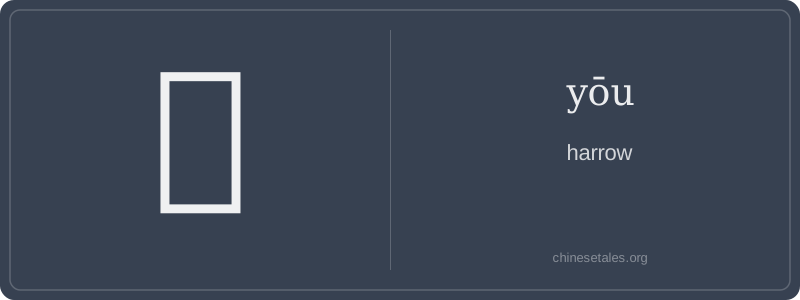
The earliest form of 櫌 appears in Han dynasty bamboo slips and late Warring States inscriptions — not oracle bones, since harrows became widespread only after iron tools matured. Its structure is transparent: the left radical 木 (mù, 'tree/wood') anchors it firmly in the realm of wooden implements, while the right side 幽 (yōu) originally depicted two mountain-like shapes enclosing a thread — suggesting something hidden, deep, or shaded. Over centuries, 幽 simplified and fused visually with 木, yielding the modern 櫌: a wooden tool designed to work *deep* in the soil, pulling through darkness beneath the surface.
By the Han, 櫌 was already standard in agricultural manuals like the *Fan Shengzhi Shu* (c. 1st c. BCE), where it appears alongside terms for plowing and seeding. The character’s visual logic held: wood + depth = a tool for subsoil refinement. In Tang poetry, it occasionally surfaces metaphorically — Li Bai once wrote of ‘harrowing the heart’s field’ (櫌心田), using it as a rare, potent image of inner cultivation. Its shape never changed drastically because its function remained stable: it wasn’t replaced by innovation — it was absorbed into broader terms like 耙 — making 櫌 a fossilized word, beautifully preserved in script but retired from speech.
Let’s be honest: 櫌 (yōu) is a quiet character — not flashy like 爱 or dramatic like 死, but deeply rooted in China’s agrarian soul. It means 'harrow': that heavy, toothed wooden or iron farm implement dragged across plowed fields to break up clods and level soil before sowing. In Chinese, it carries the tactile weight of earthwork — not just a tool, but a symbol of preparation, patience, and cyclical labor. You’ll almost never hear it in daily conversation today (hence its absence from HSK), but when it appears — especially in classical texts or regional farming reports — it evokes the rhythm of traditional agriculture.
Grammatically, 櫌 functions as a noun, almost always in compound nouns (like 櫌耙 or 櫌地), and rarely stands alone. Learners shouldn’t try to use it verbally (e.g., *‘I harrowed the field’ → *我櫌了地) — modern Mandarin uses verbs like 耙 (bà) or 平整 (píngzhěng) instead. If you see 櫌 in writing, it’s likely part of a technical term, historical description, or poetic reference — think ‘the old farmer sharpened his 櫌 at dawn,’ not ‘I need to buy a 櫌.’
Culturally, 櫌 reminds us how deeply Chinese script encodes material life: this character isn’t abstract philosophy — it’s wood grain, iron teeth, and dust on sunburnt forearms. A common mistake? Assuming it’s related to sound (yōu) — but no, it’s purely semantic. Also, don’t confuse it with similar-looking characters like 悠 or 优; those are about mood or quality, while 櫌 is stubbornly, gloriously agricultural.