櫜
Character Story & Explanation
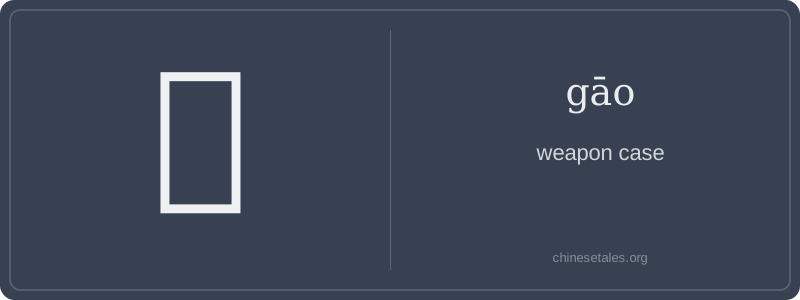
The earliest form of 櫜 appears in bronze inscriptions of the Western Zhou (c. 1046–771 BCE) — not as a detailed picture, but as a stylized ‘container with suspended contents’: two vertical lines framing a central ‘X’-shaped glyph representing crossed bows or arrows, all perched atop a base resembling a stand or platform. Over centuries, the ‘X’ evolved into the top component 亠 (a roof-like cover), the flanking elements hardened into the left and right shapes (later standardized as the ‘bow-and-arrow’ motif), and the base transformed into the 木 (wood) radical — anchoring the meaning in material reality.
By the Warring States period, 櫜 was firmly associated with the ritual act of ‘storing arms in peace’ — a key Confucian ideal captured in the phrase ‘櫜弓矢而弗用’ (‘sheath the bow and arrows, and do not use them’). In the Book of Rites, it appears alongside ceremonial armor descriptions, always emphasizing containment, reverence, and transition from war to harmony. Visually, the character’s symmetry and layered structure mirror the careful stacking of bows inside a lacquered case — each stroke a plank, each curve a strap.
Let’s crack open 櫜 (gāo) like an ancient weapon chest — because that’s exactly what it is: a specialized, archaic term for a leather or wooden case used to carry bows, arrows, or other martial gear. It’s not just ‘case’ — it’s *warrior-grade* storage, evoking ritual, readiness, and battlefield logistics. You won’t hear it in daily chat; this character lives in classical poetry, historical texts, and museum labels — think of it as the Chinese equivalent of ‘scabbard’ or ‘quiver’, but with deeper ceremonial weight.
Grammatically, 櫜 functions almost exclusively as a noun, often appearing in literary compound nouns (like 櫜鞬) or as a standalone object in parallel structures. It rarely takes modifiers like adjectives or measure words — instead, it appears in fixed phrases such as ‘櫜弓矢’ (to sheathe bow and arrow), symbolizing the end of war. Learners might mistakenly treat it like modern 包 (bāo, ‘bag’) or 箱 (xiāng, ‘box’), but 櫜 implies purpose, hierarchy, and historical context — using it casually would sound like quoting Confucius at a coffee shop.
Culturally, 櫜 carries echoes of Zhou dynasty military rites and Tang poetry’s nostalgia for chivalric order. A common trap? Misreading it as 高 (gāo, ‘high’) due to identical pronunciation — but while 高 lifts your gaze upward, 櫜 grounds you in the warrior’s belt. Also, its radical — 木 (wood) — reminds us these cases were traditionally carved from hardwood or reinforced with lacquered wood, not woven reeds or cloth. So yes: it’s rare, it’s wooden, and it’s armed.