枥
Character Story & Explanation
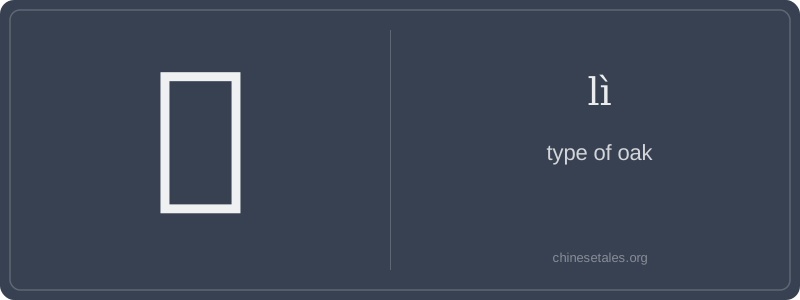
The earliest form of 枥 appears in bronze inscriptions (c. 1000 BCE) as a stylized tree with three distinct branches and a pronounced root system — unmistakably arboreal. Over time, the top simplified into two horizontal strokes (一 and 二), the trunk became the vertical 丨, and the roots evolved into the right-side component — which looks like 立 (lì, ‘to stand’) but is actually a corrupted depiction of oak roots gripping rocky soil. By the Small Seal Script (221 BCE), the left 木 (mù, ‘tree’) radical anchored its botanical identity, while the right side solidified as 立 — not for meaning, but for sound (both 枥 and 立 are lì), making this a classic phono-semantic compound.
Here’s the twist: in early Han texts, 枥 was borrowed *phonetically* to write ‘manger’ (as in horse troughs), because ‘lì’ sounded close to the local word for feeding trough — and since horses were often stabled near oak groves, the visual association stuck. That’s why Du Fu’s famous line ‘老骥伏枥’ doesn’t mean ‘old steed beside an oak’ — it means ‘old steed crouching by its manger’, using 枥 purely for its sound. Only later did botanists reclaim it for the oak species, cementing its dual legacy: a tree that sounds like a trough, and a trough that borrowed a tree’s name.
Let’s crack 枥 (lì) open like a walnut — because that’s exactly what it is: a type of oak, specifically the Quercus aliena, known in Chinese botany as ‘li oak’ or ‘Chinese cork oak’. It’s not just any tree — its bark yields high-quality cork, and its acorns were historically foraged for food and livestock feed. The character feels earthy, sturdy, and quietly utilitarian — no poetic flourishes here, unlike 梧 (wú, phoenix tree) or 榕 (róng, banyan). You’ll rarely see it in daily speech; it lives in forestry reports, botanical texts, and classical poetry where oaks symbolize resilience.
Grammatically, 枥 is strictly a noun — never a verb or adjective — and almost always appears in compound nouns (e.g., 枥树, 枥木) or with measure words like ‘棵’ (kē, for trees) or ‘株’ (zhū, for individual plants). Learners sometimes wrongly treat it like 林 (lín, forest) or 李 (lǐ, plum), but note: it has no pluralizing function, no verb derivations, and zero colloquial diminutives. Its tone is fourth (lì), sharp and decisive — like tapping knuckles on oak wood.
Culturally, 枥 hides a quiet irony: though it means ‘oak’, it’s almost never used to mean ‘oak’ in modern spoken Mandarin — speakers say 橡树 (xiàngshù) instead. 枥 survives mainly in literary or technical registers, and even many native speakers only recognize it from Du Fu’s line ‘老骥伏枥’ (lǎo jì fú lì, ‘an old steed crouches by the manger’), where 枥 was misread for centuries as ‘manger’ (due to phonetic borrowing) — a delightful historical mix-up we’ll explore in the story section!