栊
Character Story & Explanation
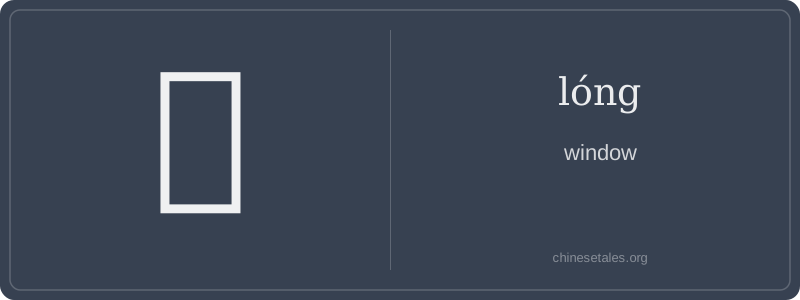
The earliest form of 栊 appears in seal script (around 220 BCE), where it clearly combines 木 (mù, ‘tree/wood’) on the left and 龙 (lóng, ‘dragon’) on the right. The 木 radical signals its material origin—wooden construction—while 龙 wasn’t chosen for mythic power, but for phonetic function: both 龙 and 栊 share the same pronunciation lóng and were historically interchangeable in sound-based character formation (phonetic loan). Over time, the dragon’s sinuous curves simplified into the modern right-hand component—no longer picturing a coiling beast, but preserving its sonic identity like a hidden musical signature in the strokes.
This character first appeared in texts like the *Book of Rites* (Lǐjì) describing palace architecture, where ‘朱栊碧槛’ (vermilion lattices and emerald thresholds) evoked imperial refinement. By the Tang and Song dynasties, poets used 栊 to conjure atmosphere—not just structure. Li Qingzhao wrote of ‘风住尘香花已尽,日晚倦梳头。物是人非事事休,欲语泪先流。闻说双溪春尚好,也拟泛轻舟。只恐双溪舴艋舟,载不动许多愁。’ — though she doesn’t use 栊 here, her contemporaries did, pairing it with silk curtains (纱栊), moonlight (月栊), or rain (雨栊) to suggest fragility and transience. Visually, its nine strokes map perfectly onto the idea: four strokes for the wooden frame (木), five for the intricate, rhythmic latticework (龙)—a microcosm of harmony between structure and art.
Don’t let the simple meaning ‘window’ fool you—栊 (lóng) isn’t your everyday window. It’s a *classical*, almost poetic word for the ornate wooden lattice frame that holds panes or paper in traditional Chinese architecture—think of delicate carved screens in Suzhou gardens or the moon gates framing courtyards. This isn’t ‘window’ as in ‘open the window to let air in’ (that’s 窗 chuāng); 栊 evokes craftsmanship, light filtering through patterned wood, and quiet elegance. You’ll rarely hear it in spoken Mandarin today—it lives in literature, poetry, and architectural descriptions.
Grammatically, 栊 is almost always part of compound nouns—not used alone. It never takes aspect particles like 了 or 过, nor does it appear in verb phrases. You won’t say ‘I look out of the 栊’; instead, you’ll encounter it in fixed terms like 纱栊 (shā lóng, gauzy window screen) or 朱栊 (zhū lóng, vermilion-painted lattice). Learners sometimes mistakenly substitute it for 窗 or 槛 (kǎn, threshold), but doing so strips away centuries of aesthetic nuance—and may make your sentence sound like a Tang dynasty poem accidentally quoted in a subway announcement.
Culturally, 栊 carries a soft, introspective mood: it’s the window you see *through*, not *out of*. In classical poetry, it often frames melancholy or contemplation—like Du Fu observing falling blossoms ‘beyond the red lattice’. A common mistake? Pronouncing it as ‘lǒng’ (like 笼)—but no: it’s always lóng, with a level tone, echoing the calm, unbroken rhythm of lattice geometry. Mastering 栊 means stepping into China’s visual language—not just vocabulary.