櫹
Character Story & Explanation
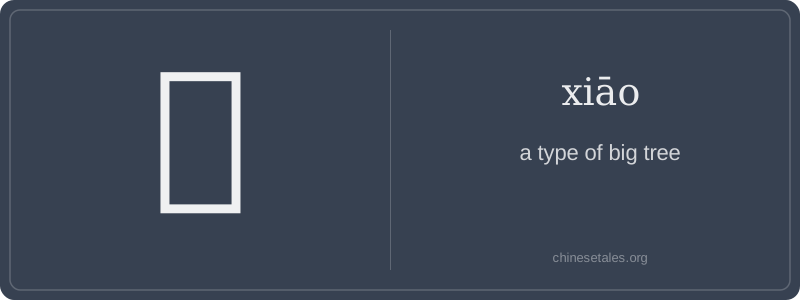
The character 櫹 first appeared in seal script during the Warring States period, evolving from a pictographic fusion: the left side 木 (mù, 'tree') anchors its meaning, while the right side 蕭 (xiāo, originally 'withered reeds' or 'sparse grasses') was borrowed for sound *and* subtle semantic nuance — suggesting tall, slender, wind-swept growth. Over time, clerical script simplified the grass component 艹 into 肅 (sù), then further stylized into the modern 肅-like top-right form, preserving both phonetic value (xiāo) and an elegant verticality echoing the tree’s stature.
By the Han dynasty, 櫹 was firmly established in botanical texts like the Shuō Wén Jiě Zì as a specific arborescent term, distinguished from generic trees by its association with high-altitude groves and resonant timber. In Du Fu’s poetry, 櫹 appears metaphorically — 'the 櫹 sighs in autumn wind' — where its rustling leaves become synesthetic shorthand for melancholy grandeur. Visually, the character’s towering vertical stroke (the central line of 肅) mimics the tree’s trunk, while the clustered strokes at the top evoke dense, layered foliage — a rare case where calligraphic structure mirrors ecological form.
Meet 櫹 (xiāo) — a botanical deep-cut with serious old-school charm. It’s not just 'a big tree'; it specifically names a tall, graceful deciduous tree (often identified as the Chinese wingnut or related species), prized in classical poetry for its stately height and rustling leaves. You won’t hear it in daily chat — it’s literary, poetic, and deeply rooted in imagery of elegance and endurance. Think of it as the Mandarin equivalent of calling an oak 'a Quercus robur' instead of just 'an oak': precise, evocative, and quietly impressive.
Grammatically, 櫹 behaves like most noun-classifier nouns: it appears after measure words (e.g., 一株櫹 — yī zhū xiāo, 'one tree of the xiāo kind') or in compound nouns. It rarely stands alone in speech — you’ll almost always see it in set phrases like 櫹櫸 (xiāo jǔ) or in classical couplets. A common learner mistake? Assuming it’s interchangeable with more common tree words like 松 (sōng, pine) or 柏 (bǎi, cypress). But 櫹 isn’t about coniferous evergreens — it’s about broad-leaved grandeur, seasonal change, and lyrical resonance.
Culturally, 櫹 is a quiet symbol of scholarly refinement — its presence in Tang and Song dynasty poems often signals a serene, cultivated landscape, sometimes paired with scholars’ retreats or temple gardens. Modern readers might misread its radical (木) and assume it’s colloquial, but no — its rarity means it’s a 'literary fossil', preserved mainly in texts, botanical glossaries, and calligraphic art. If you encounter it, pause: you’re not just reading a word — you’re stepping into a centuries-old grove.