櫽
Character Story & Explanation
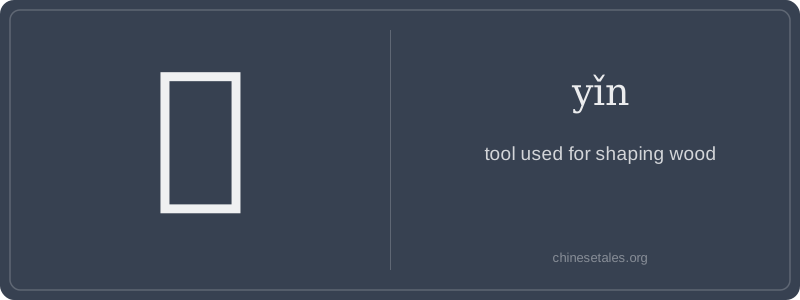
The earliest attested form of 櫽 appears in Han dynasty bronze inscriptions and early dictionaries like the Shuōwén Jiězì (121 CE), where it’s analyzed as a phono-semantic compound: the left side 木 (mù, 'tree/wood') signals category, while the right side 隱 (yǐn, 'to conceal, hide') provides sound — but also hints at function: the tool 'hides' or 'subdues' the wood’s natural resistance, bending it out of sight of its original state. Visually, it evolved from a simple wood-sign + phonetic cluster into today’s 18-stroke form, with the 隱 component retaining its layered structure: 阝 (hill/enclosure) + 彐 (a hand holding something) + 丨 + 一 — suggesting containment and control over raw material.
In the Guǎnzǐ (4th c. BCE) and later literary criticism, 櫽 took on abstract life: 櫽栝 became a rhetorical term for 'condensing and refining' unwieldy texts into elegant, orthodox forms — much like bending wild bamboo into a perfect qin bridge. The character’s very shape — heavy, enclosed, vertically stacked — mirrors its semantic role: imposing disciplined order on unruly substance. Its rarity today isn’t decline, but preservation — like finding a Renaissance joiner’s plane in a modern workshop: unchanged, precise, and quietly authoritative.
Think of 櫽 (yǐn) as the ancient Chinese equivalent of a 'wood-bending jig' — not a saw or chisel, but that specialized metal or wooden form carpenters clamp wet wood around to force it into elegant curves for chair backs or qin zithers. It’s a hyper-specific tool noun, almost archaeological in feel: you won’t hear it in modern conversation, and even many native speakers only encounter it in classical texts or woodworking treatises. Its meaning is tightly bound to *intentional, controlled reshaping* — never accidental warping.
Grammatically, 櫽 functions exclusively as a noun, usually in compound terms like 櫽括 (yǐnkuò) or 櫽栝 (yǐnguā), where it contributes the sense of 'standardizing', 'rectifying', or 'bringing into proper form'. You’ll never see it alone in a sentence — it’s a fossilized root, like 'thou' in English poetry: meaningful only in set phrases. Learners mistakenly try to use it as a verb ('to shape') or pair it with modern measure words — but it resists such usage entirely.
Culturally, 櫽 carries quiet philosophical weight: Confucian scholars used 櫽栝 metaphorically to describe the moral 'straightening' of human nature — aligning one’s conduct with ritual (lǐ) and virtue (dé). A common pitfall? Pronouncing it as yīn (like 因) — the tone is *third*, not first. And don’t confuse its wood radical (木) with the 'hand' radical (扌) — this isn’t about manual action, but about the *tool itself* that imposes form on material.