欙
Character Story & Explanation
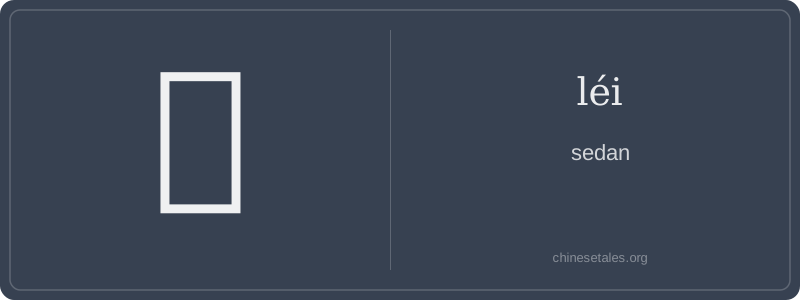
The earliest known form of 欙 appears on Han dynasty bronze inscriptions—not as a pictograph, but as a *phonosemantic compound*: the left side 車 (chē, ‘cart/vehicle’) signals meaning, while the right side 畾 (léi, an ancient variant of 田 with doubled fields) was chosen for its sound, not its meaning. Over centuries, 畾 simplified into 雷 (léi, ‘thunder’), then further stylized into the modern right-hand component—though no thunder ever rumbled near a sedan! The strokes didn’t depict wheels or poles; they encoded pronunciation while anchoring the concept to transport.
By the Tang dynasty, 欙 appeared in Du Fu’s poems describing imperial processions, always paired with verbs like ‘lifted’ (抬) or ‘covered’ (罩), emphasizing its ceremonial weight. Its meaning never broadened—it stayed rigidly tied to *portable, enclosed, human-carried conveyances for dignitaries*. Unlike 轎, which absorbed colloquial usage, 欙 remained frozen in literary register—its visual complexity mirroring the social rigidity it represented. Even today, calligraphers choose 欙 over 轎 in scrolls precisely because its ornate form *feels* more prestigious—and more distant.
Imagine a bustling 18th-century Yangzhou street: silk merchants in scholar’s hats, tea-sellers calling out, and suddenly—*clack-clack-clack*—a lacquered sedan chair carried by four bearers glides past, its bamboo-and-silk canopy swaying. That’s 欙 (léi): not just any chair, but a *human-powered luxury vehicle*—the elite’s private ride before cars, bicycles, or even proper roads. It evokes elegance, hierarchy, and quiet authority; you’d never use it for a bus or a stool—it’s inherently aristocratic and archaic.
Grammatically, 欙 is almost exclusively a noun, and rarely appears alone in modern speech—it’s nearly always embedded in compounds like 轿子 (jiào·zi, ‘sedan chair’) or historical terms like 八抬大轎 (bā tái dà jiào, ‘eight-bearer grand sedan’). You won’t say ‘I ride a 欙’—instead, you’d say ‘坐轎子’ (zuò jiào·zi). Crucially, 欙 itself is *not used in isolation today*; learners who try to substitute it for 轿 (jiào) in everyday contexts will sound like they’re quoting Ming-dynasty opera scripts.
Culturally, this character is a linguistic time capsule: it appears in Tang poetry and Song legal codes, but vanished from spoken Mandarin centuries ago—replaced entirely by the simpler, more phonetic 轿. Mistake? Yes—many learners assume 欙 is the standard character because it looks ‘more classical’, but it’s actually obsolete except in rare literary or stylistic revival contexts. Its survival is purely typographic, not functional.