欷
Character Story & Explanation
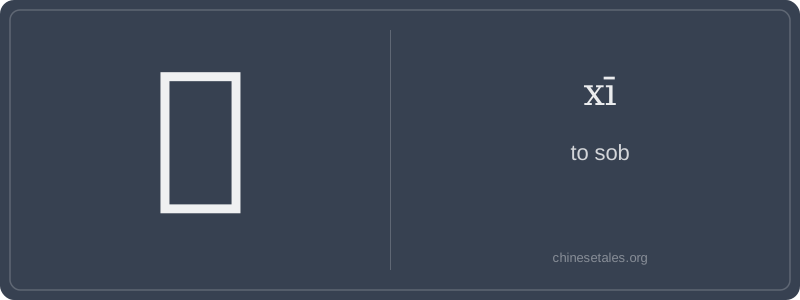
The earliest form of 欷 appears in bronze inscriptions as a combination of 欠 (qiàn, 'to yawn' or 'to lack', depicting a person with open mouth and raised arms) and 希 (xī, 'rare', originally picturing a cloth stretched thin over a frame — suggesting fragility and tension). Over time, 希 simplified into its modern shape (a 'grain' radical 米 atop 'mountain' 山, then further stylized), while 欠 retained its open-mouthed posture. The eleven strokes crystallize this duality: the left side 欠 shows the physical act — jaw dropped, breath caught — and the right side 希 evokes rarity, thinness, fragility — the emotional state where composure frays at the edges.
In the Classic of Poetry (Shījīng), 欷 appears in elegiac odes describing mourners ‘heaving sighs’ — not weeping openly, but trembling with suppressed lament. By the Tang dynasty, poets like Du Fu used 欷歔 to convey moral anguish: the sob wasn’t just personal grief, but sorrow for a fallen empire. Visually, the character’s asymmetry — the delicate, intricate 希 leaning slightly into the open-mouthed 欠 — mirrors how emotion destabilizes equilibrium: one part breathes, the other breaks.
At its heart, 欷 (xī) is the quiet, shuddering sob — not the loud wail of 哭 (kū), nor the choked gasp of 噎 (yē), but that involuntary, breath-catching tremor deep in the chest when grief or overwhelming emotion rises too fast to suppress. It’s an onomatopoeic verb rooted in sound and physiology: the 'xī' syllable mimics the sharp, inward pull of breath before a tear breaks loose. You’ll almost never see it alone; it appears almost exclusively reduplicated as 欷歔 (xī xū), where the repetition mirrors the rhythmic catch-and-release of sobbing.
Grammatically, 欷 is strictly literary and formal — think classical poetry, elegies, or solemn modern essays. It’s never used in casual speech ('I’m sobbing' = 我在哭, not 我在欷). As a verb, it’s intransitive and usually appears in descriptive phrases like 欷歔不已 (xī xū bù yǐ — 'sobbing uncontrollably') or paired with nouns like 欷歔之声 (xī xū zhī shēng — 'the sound of stifled sobs'). Learners often mistakenly treat it as a standalone action verb — but without 欷歔 or context, it feels archaic, incomplete, even jarring.
Culturally, 欷 carries the weight of restrained sorrow — Confucian dignity in grief. Unlike Western expressions of raw emotion, 欷 implies emotional gravity held just barely in check. A common mistake? Using it in spoken contexts or confusing it with similar-sounding verbs like 吸 (xī, 'to inhale') — which shares the same radical but has zero emotional resonance. Remember: 欷 isn’t breathing *in* — it’s the breath that *stutters* on the way back out.