歁
Character Story & Explanation
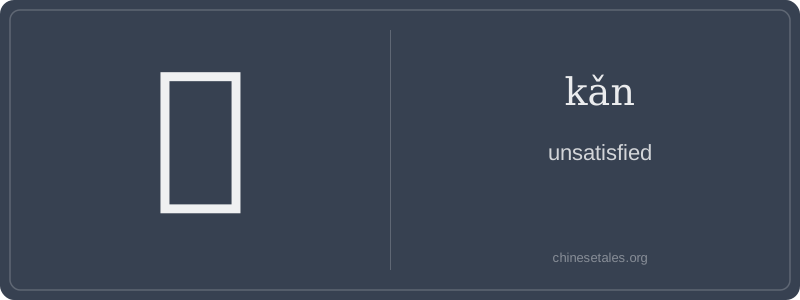
The earliest form of 歁 appears on Warring States bamboo slips as a composite glyph: the left side was a variant of 欠 (qiàn), depicting a person with mouth agape — symbolizing breath, yearning, or lack; the right side was 甚 (shèn), meaning 'excessive' or 'extreme', but here functioning phonetically and semantically to intensify the sense of insatiability. Over centuries, the 欠 radical simplified, the 甚 morphed into a compact, angular form with three horizontal strokes and a downward hook — eventually crystallizing into today’s 歁, where every stroke feels like a sigh held too long.
This character thrived in early Daoist and Chan Buddhist texts to describe the mind’s restless hunger — for example, in the Zhuangzi, where sages are praised for transcending 歁心 (kǎn xīn, 'the unsatisfied heart'). By the Tang dynasty, it had faded from prose into poetry and calligraphy colophons, where artists would inscribe 歁然 after an unfinished sketch — not as failure, but as deliberate openness. Its visual austerity mirrors its meaning: no flourish, no resolution — just the clean, hollow space between wanting and being.
Let’s be honest: 歁 (kǎn) is a ghost character — elegant, ancient, and nearly extinct in modern speech. It means 'unsatisfied' or 'unfulfilled', but not in the casual way we say 'I’m not satisfied with my coffee'. It carries a deep, almost philosophical weight — like a scholar gazing at an unfinished scroll, or a poet whose verse falls short of the feeling in his heart. It’s introspective, quiet, and tinged with melancholy.
Grammatically, 歁 is almost always used as a stative verb or adjective in classical or literary contexts — never as a standalone predicate in colloquial Mandarin. You won’t hear it in daily chat; instead, it appears in set phrases like 歁然 (kǎn rán, 'with a look of unfulfillment') or compounds like 不歁 (bù kǎn, 'not unsatisfied' → i.e., 'content'). Think of it as the literary cousin of 满足 (mǎn zú) — its opposite isn’t just 'dissatisfied', but a kind of existential incompleteness that lingers in silence.
Culturally, 歁 reflects a Confucian-Buddhist sensibility: the awareness that desire can never fully settle, and that true peace lies not in getting what you want, but in releasing the wanting itself. Learners often misread it as 谦 (qiān, 'humble') due to visual similarity — but that’s a dangerous mix-up: confusing unfulfillment with humility changes your entire moral posture! Also, note: it’s *never* used in imperative or progressive forms — no 歁着 or 歁了. Its power lives only in stillness and brevity.