歛
Character Story & Explanation
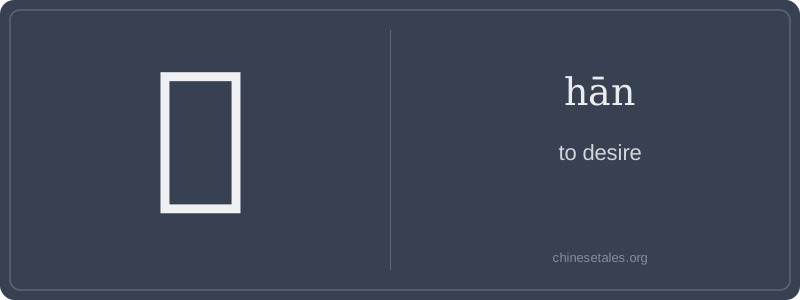
The earliest form of 歛 appears in Warring States bamboo texts — not oracle bones, but inked on slender slips — as a compound glyph: a stylized 'mouth' (口, later evolving into the top component 亼) over a simplified 'person' (人) beside 欠 (a kneeling figure with open mouth, symbolizing breath or yearning). Over centuries, the person became 丷 (two dots), the mouth hardened into 亼 (a covered container), and 欠 remained steadfast at the bottom — 17 strokes capturing the image of desire *contained within the self*, not projected outward. The modern shape feels dense, vertical, almost meditative — like a sealed scroll holding intense feeling.
This visual containment shaped its meaning: 歛 didn’t mean 'to want' in the sense of reaching out, but 'to gather desire inward', to hold it close, sometimes even suppress it. In the Han Shu (Book of Han), it appears in phrases like '歛懷不發' (hān huái bù fā) — 'gathering one’s yearning without expressing it' — describing virtuous restraint. Its sound hān mimics a soft, controlled exhale: the very breath of contained longing. Unlike desire-characters born from action (e.g., 求 'to seek'), 歛 is born from stillness — making it one of Chinese’s most poetically paradoxical verbs.
Let’s be honest: 歛 (hān) is a linguistic ghost — it’s real, it’s ancient, and it *means* 'to desire', but you’ll almost never see it in modern Chinese. Unlike common desire-words like 想 (xiǎng) or 希望 (xīwàng), 歛 carries a rare, almost archaic flavor of deep, inward yearning — not casual wanting, but the kind that tugs at your breath (hence the 欠 radical, which relates to breathing, sighing, or opening the mouth in longing). It’s not used predicatively ('I desire') or as a verb in daily speech; instead, it appears almost exclusively in classical compounds, literary allusions, or poetic modifiers — think of it as the 'velvet rope' character: elegant, exclusive, and quietly powerful.
Grammatically, 歛 behaves like a literary verb or adjective root — you won’t say '我歛' (wǒ hān); rather, it shows up in fixed expressions like 歛懷 (hān huái, 'to hold desire inwardly') or 歛志 (hān zhì, 'to suppress one’s ambition'). Learners often mistakenly treat it like 羡 (xiàn, 'to envy') or 慕 (mù, 'to admire'), but those are active, outward-facing emotions — 歛 is about *containing*, even *restraining* desire. Its tone (hān, first tone) is soft and aspirated, mirroring its quiet intensity.
Culturally, 歛 echoes Confucian ideals of emotional restraint: desire isn’t denied, but gathered, refined, and held with dignity. A classic mistake? Using it in spoken Mandarin — it’ll sound like quoting an oracle bone inscription at a coffee shop. And yes, it’s not in the HSK list for good reason: it’s more museum piece than textbook staple. But knowing it unlocks layers of classical poetry, where a single 歛 can whisper volumes about unspoken longing.