歠
Character Story & Explanation
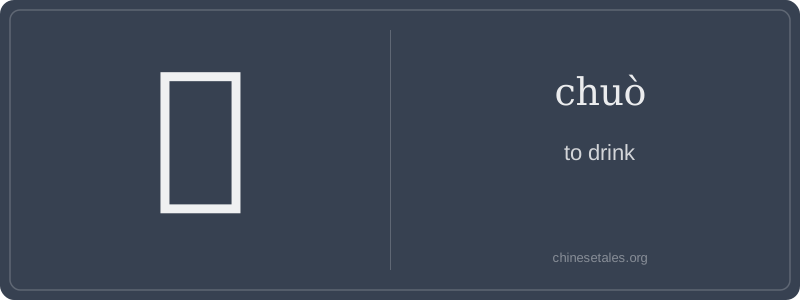
The earliest form of 歠 appears on Warring States bamboo slips, not oracle bones — and it’s a masterpiece of semantic engineering. The left side, 飲 (yǐn, 'to drink'), is itself a pictograph of a person with mouth open, bending over a vessel. The right side, 瞅 (chǒu) — wait, no! That’s a red herring. Actually, the right component is 氵+叕 (zhuó), where 叕 is an ancient symbol for 'repeated action', suggesting repeated small sips. Over centuries, the top part simplified from a detailed 'person + vessel' into today’s 飮 radical, while the 叕 morphed into the squiggly strokes beneath — giving 歠 its distinctive layered, downward-flowing look, like liquid trickling through narrow channels.
This visual descent mirrors its meaning: not swallowing, but drawing liquid *up* gently — a subtle inversion that reflects ancient Chinese attention to breath and flow. Mencius (Mengzi) famously wrote, '君子不歠冷酒' ('A gentleman does not sip cold wine'), linking 歠 to moral cultivation: temperature, timing, and manner all mattered. The character’s very structure — dense, vertical, requiring careful stroke order — enacts the slowness it describes. To write 歠 is to perform the act: each downward stroke a measured sip, each pause between strokes a breath held in reverence.
Think of 歠 (chuò) not as a casual sip from a coffee cup, but as the solemn, almost ritualistic act of drinking — slow, deliberate, and often with reverence. It’s a literary and classical word, rarely heard in modern spoken Mandarin (hence its absence from HSK), but alive in poetry, historical texts, and refined prose. Its core feeling is *contained intensity*: imagine sipping hot tea in silence during a Chan meditation, or a scholar lifting a bronze wine vessel at a Zhou dynasty banquet — no gulping, no chugging, just mindful, measured intake.
Grammatically, 歠 functions as a verb, usually transitive, and pairs naturally with elegant or archaic nouns: 歠茶 (chuò chá, 'to sip tea'), 歠粥 (chuò zhōu, 'to sip thin gruel'). Unlike everyday verbs like 喝 (hē), 歠 never appears in commands ('Drink up!') or imperatives; it’s always descriptive, often in past or literary narrative tenses. Learners mistakenly insert it into conversational sentences — saying '我歠水' sounds like quoting Confucius mid-sip, not ordering water at a restaurant.
Culturally, 歠 carries echoes of restraint and refinement. In classical etiquette, loud drinking was vulgar — 歠 implied quiet control. A common pitfall? Overusing it thinking it’s 'more formal than 喝'. But it’s not just formal — it’s *time-traveling*. Using it outside classical or poetic contexts feels like wearing hanfu to a Zoom meeting: beautiful, but contextually jarring. Its rarity makes it a linguistic artifact — admired, studied, but carefully deployed.