歾
Character Story & Explanation
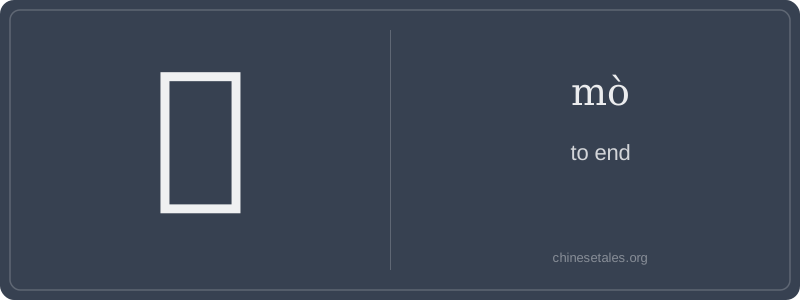
Carved on late Warring States bamboo slips, 歾 began as a radical fusion: the ‘death’ radical 歹 (dǎi) on the left — a stark, jagged bone fragment — fused with the phonetic component 末 (mò), meaning ‘end/tip of a tree branch’, on the right. Visually, it’s a corpse beside the very last twig — an image of absolute termination, not decay, not transition, but the final node. Over centuries, the 末 component simplified: its two horizontal strokes flattened, the vertical stroke sharpened, and the dot above merged into the top stroke — yielding today’s crisp, austere 歾.
This visual logic shaped its meaning: in the *Zuo Zhuan*, 歾 marked the extinction of noble lineages; in Tang stele inscriptions, it denoted the ‘ending’ of a vow before heaven. Unlike 殒 (yǔn, ‘to perish violently’) or 卒 (zú, ‘to die’), 歾 conveys silent, natural, almost administrative cessation — as if time itself filed paperwork. Its form doesn’t shout; it seals. That quiet finality is why it survives only in gravestones, historical prefaces, and the sigh of a scholar turning the last page of a fallen dynasty’s annals.
Let’s be honest: 歾 is a ghost character — elegant, archaic, and nearly extinct in daily speech. Its core meaning isn’t just ‘to end’ in the neutral sense of ‘finish homework’; it carries the solemn, irreversible finality of death, dissolution, or cosmic cessation — think ‘the dynasty 歾’, ‘the covenant 歾’, or ‘his name 歾 from history’. It feels like sealing a scroll with wax: decisive, ceremonial, and slightly mournful.
Grammatically, 歾 is almost exclusively literary and transitive — it takes a subject that *undergoes* ending, often abstract entities (dynasties, eras, vows, lineages). You’ll never say ‘wǒ chī wán le’ with 歾 — no snack-sized endings here. Instead, it appears in classical syntax: subject + 歾 + (optional object), usually without aspect particles like 了 or 过. Learners mistakenly try to use it like 结束 or 终止, but those are active, controllable verbs — 歾 implies fate, inevitability, or quiet erasure.
Culturally, 歾 is the whisper behind Confucian historiography: historians used it to mark dynastic collapse without assigning blame — a dignified, face-saving fade-to-black. Modern learners rarely encounter it outside classical texts or poetic headlines, so mispronouncing it as mò (not mò *or* wěn) or confusing it with 殁 (its simplified variant) is common. And yes — it’s not in HSK *because* it’s functionally retired from spoken Mandarin. Think of it as Chinese Latin: beautiful, precise, and reserved for epitaphs and emperors’ obituaries.