殆
Character Story & Explanation
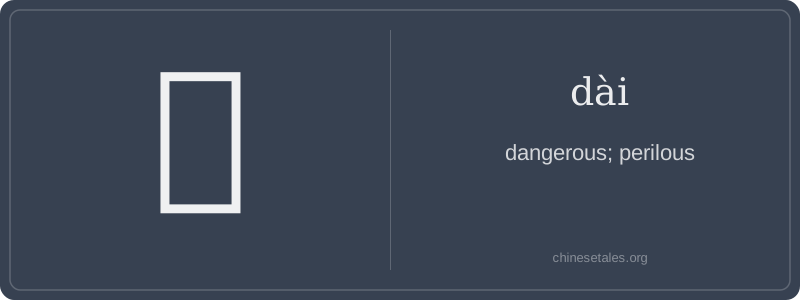
The earliest form of 殆 appears in bronze inscriptions as a composite: the left side was 歺 (a variant of 歹, depicting a bare skeleton or corpse with a missing leg — symbolizing decay and death), and the right side was 台 (tái), which originally depicted a stepped altar or platform but functioned phonetically. Over time, 台 simplified into 台 (still pronounced tái, but here serving as a sound clue for dài), while the 歺 radical hardened into 歹. By the seal script era, the nine strokes were fixed: the stark, angular 歹 on the left, and the balanced, slightly top-heavy 台 on the right — visually echoing instability itself.
This character first appeared in pre-Qin texts to mean 'exhausted to the point of death' or 'on the brink of ruin'. In the Zuo Zhuan, it describes armies 'so depleted they were 殆', and in Mencius, it conveys moral exhaustion — 'a ruler who loses benevolence is 殆'. Crucially, the visual duality matters: the death radical grounds the meaning in mortality, while the phonetic 台 (which also appears in 怡, 'joy') creates ironic tension — as if peril wears a mask of calm. This subtle dissonance makes 殆 unforgettable once you see it.
Think of 殆 (dài) as the Chinese equivalent of the 'caution tape' around a crumbling bridge — not just 'dangerous', but *imminently, gravely perilous*, often with an undertone of exhaustion or near-failure. Unlike the more general 危险 (wēixiǎn), which is your standard 'warning sign', 殆 carries literary weight and classical gravity: it’s the word Confucius used in the Analects to describe a mind worn thin by overthinking ('学而不思则罔,思而不学则殆' — 'Learning without thinking leads to confusion; thinking without learning leads to peril').
Grammatically, 殆 rarely stands alone as a standalone adjective like 'dangerous' in English. Instead, it appears in formal compounds (e.g., 危殆, 殆尽) or as a classical adverb meaning 'almost', 'nearly' — as in 殆将崩溃 (dài jiāng bēngkuì), 'is on the verge of collapse'. Learners often mistakenly use it like a modern synonym for 危险, but that’s like using 'perilous' instead of 'dangerous' in every email — technically correct, but jarringly archaic.
Culturally, 殆 embodies a uniquely Chinese philosophical tension: danger isn’t just external — it’s the internal state of being *on the edge of moral, intellectual, or physical dissolution*. A common error is misreading it as dài (like 待) when it’s always dài — never dài (second tone). Also, its radical 歹 (dǎi, 'death') isn’t decorative: it’s a grim anchor, reminding you this character doesn’t whisper warnings — it tolls a bell.