殍
Character Story & Explanation
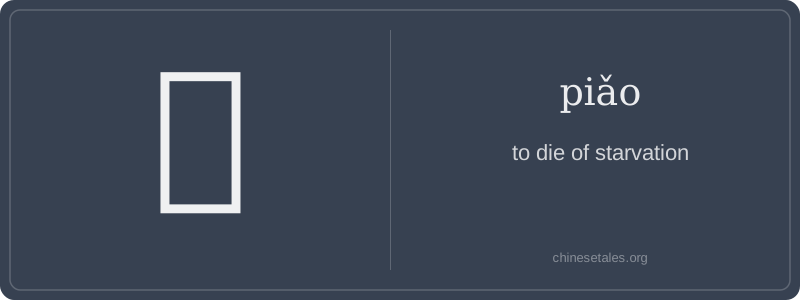
The earliest form of 殍 appears in late Warring States bamboo slips — not oracle bones — as a compound of 歹 (dǎi, 'death/corruption') on the left and 殳 (shū, an ancient weapon or striking tool) on the right. Wait — but modern 殍 has 匚 (fāng) and 乚 (yǐn) at the bottom! That’s the twist: the right side evolved from 殳 into 彳 (chì, 'step') + 匚 + 乚 via clerical script simplification, while the top-right component (丿+一+丨) emerged from stylized strokes of the original weapon glyph. Visually, it’s a corpse (歹) collapsing sideways (the curved 乚 suggests slumping) under deprivation.
This visual collapse mirrors its semantic journey: from early texts like the *Zuo Zhuan*, where it described famine victims during feudal warfare, to Mencius’ moral indictment of rulers, and later to Lu Xun’s biting essays criticizing warlord-era neglect. Its shape — a body tilting into emptiness — became inseparable from its meaning: death not by violence or illness, but by the slow, silent theft of food. Even today, the curve of that final stroke (乚) feels like a spine giving way — no wonder it’s reserved for moments when language must bear witness.
At its core, 殍 (piǎo) isn’t just ‘to die’ — it’s the grim, visceral death of starvation: hollow belly, sunken eyes, collapsed limbs. The character radiates moral gravity; in classical and modern usage, it never appears casually. You won’t find it in daily chat or HSK textbooks because it belongs to solemn registers — historical accounts, literary criticism, or political essays describing societal collapse. It’s a verb, but almost always used in passive or descriptive constructions (e.g., ‘路有饿殍’ — 'starving corpses line the roads'), rarely as an active ‘I starved’.
Grammatically, 殍 functions primarily as a noun meaning 'a corpse who died of hunger' — yes, despite dictionaries listing it as a verb, native speakers overwhelmingly use it this way. When it does act as a verb (e.g., in classical parallelism), it’s highly literary and often paired with characters like 饿 (è, 'to starve') or 流 (liú, 'to flee'). Learners mistakenly treat it like a regular verb (‘他殍了’), but that’s ungrammatical — instead, say 他饿殍而死 (tā è piǎo ér sǐ, 'he died of starvation') or simply use it as a noun: 饿殍遍野 (è piǎo biàn yě, 'starving corpses everywhere').
Culturally, 殍 is a linguistic landmine — loaded with Confucian condemnation of failed governance. Mencius famously blamed rulers, not fate, when ‘饿殍相望’ (è piǎo xiāng wàng, 'starving corpses face each other'). Modern writers still wield it to evoke systemic injustice, not individual misfortune. A common learner trap? Assuming it’s interchangeable with 死 (sǐ) or 亡 (wáng). It’s not — using 殍 where context doesn’t demand that level of moral indictment sounds grotesquely overdramatic or even sarcastic.