殙
Character Story & Explanation
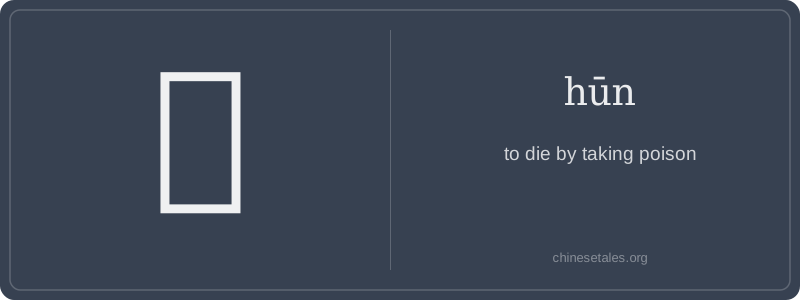
The earliest trace of 殙 appears not in oracle bones but in Warring States bamboo slips and Han dynasty bronze inscriptions, where it’s already a compound character: 歹 (dǎi, ‘corpse’ or ‘death’, originally a pictograph of a fractured, mutilated body) fused with 昏 (hūn, ‘dusk’ or ‘confusion’, itself built from 日 ‘sun’ + 民 ‘people’—evoking dimming light and loss of consciousness). Visually, the left side 歹 signals mortality; the right side 昏 suggests the disorienting, irreversible collapse induced by poison—not sudden violence, but a slow, clouding fade into darkness. Stroke order reinforces this: begin with the stark, angular strokes of 歹 (7 strokes: dot, horizontal, vertical, hook, etc.), then flow into the softer, enclosing curves of 昏 (11 strokes), mirroring toxin spreading through the body.
Its meaning crystallized early: in the Zuo Zhuan, it describes ministers who ‘drank the cup and 殙’—a euphemism for forced suicide via poison, common in court politics. By the Tang, poets like Du Fu used 殙 to heighten moral tragedy: ‘loyal ones 殙 in silence, their blood soaking the earth’. The character never shed its association with *intentional, non-combative, toxic termination*—unlike 死 (general death) or 殉 (dying for a cause). Its form is a visual metaphor: the fading sun (昏) over a corpse (歹)—the last light going out, not from battle wounds, but from something swallowed.
Imagine a character that doesn’t just mean ‘to die’—but specifically, *to die by poison*, with all the grim finality and quiet violence that implies. 殙 (hūn) is one of Chinese’s most surgically precise death-verbs: it carries forensic weight, literary gravity, and zero colloquial use. You’ll never hear it in daily speech—it lives in classical texts, historical records, and modern literary prose when an author wants to evoke deliberate, toxic self-destruction or treacherous murder. Grammatically, it’s a transitive verb (though often used without an object) and almost always appears in formal or literary contexts: ‘she 殙 herself’ is not idiomatic; instead, you’d say ‘she 殙于鸩酒’ (died from poisoned wine), where 殙 anchors the fatal agency.
Beginners often misread it as a variant of 昏 (hūn, ‘dull’ or ‘twilight’) because of identical pronunciation and similar top component—but 昏 has 日 (sun) below, while 殙 has 歹 (death radical) on the left and 昏 on the right, making its meaning unambiguously lethal. Another trap: confusing it with 死 (sǐ) or 亡 (wáng)—but those are neutral or broad; 殙 is *causally specific*: poison must be involved, implied or explicit. Its rarity means learners rarely encounter it outside annotated classics like the Zuo Zhuan or Tang dynasty poetry lamenting poisoned loyalists.
Culturally, 殙 reflects how pre-modern Chinese thought encoded moral causality into vocabulary: dying by poison wasn’t just physical—it suggested betrayal, political intrigue, or tragic integrity (e.g., a minister choosing poison over surrender). Modern usage is almost exclusively literary or historiographical—think newspaper headlines quoting ancient sources or novels recreating dynastic downfalls. No slang, no memes, no texting. It’s a word that arrives like a sealed imperial edict: solemn, irrevocable, and chillingly precise.