殣
Character Story & Explanation
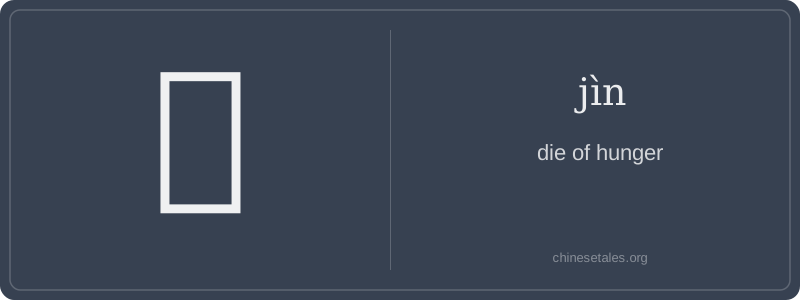
The earliest form of 殣 appears in bronze inscriptions (c. 1000 BCE) as a combination of two key elements: the radical 歹 (dǎi), meaning 'death, decay, or misfortune' — originally a stylized bone or corpse — and a phonetic component 帙 (zhì, later simplified to 晋 jìn). Wait — that’s odd! Why does a character meaning 'starve to death' borrow sound from 晋 (a word for 'advance' or 'Jin state')? Because ancient Chinese often borrowed phonetics loosely: early forms show 帙 (a silk pouch, pronounced zhì) evolving into 晋 via sound shift, and then into the modern 殣 shape. Visually, the left side 歹 anchors the meaning in mortality; the right side 晋, though seemingly unrelated, locks in the jìn pronunciation — a classic example of phono-semantic matching.
This character first appears in the *Zuo Zhuan* (c. 4th century BCE), describing famine-stricken states where 'people died of hunger, bodies unburied'. Over centuries, its usage narrowed from general 'death by deprivation' to specifically 'death by starvation' — distinguishing it from other 歹-radical characters like 殃 (yāng, 'calamity') or 殃 (yāng) or 殃 (yāng). The visual weight of 歹 + 晋 subtly mirrors its semantic gravity: a descent into nothingness, where even advancement (晋) turns futile. By the Tang dynasty, poets like Du Fu used 殣 sparingly but devastatingly — a single character carrying the silence after the last grain vanishes.
At first glance, 殣 (jìn) feels heavy — not just because it means 'to die of hunger', but because it carries the visceral, gut-wrenching finality of starvation. This isn’t a polite or abstract term like 饥饿 (jī’è, 'hunger'); 殣 is literary, solemn, and almost archaic — the kind of word you’d find in historical chronicles or classical poetry describing famine’s grim toll. It’s never used casually: you won’t hear someone say 'I’m 殣' after skipping lunch. It implies irreversible, fatal depletion — body empty, life extinguished.
Grammatically, 殣 functions as an intransitive verb, almost always in passive or descriptive constructions. You’ll see it in patterns like '饿殍遍野,民多殣' ('Corpses littered the fields; many people starved to death') or as part of compound verbs like 殣死 (jìn sǐ). Crucially, it doesn’t take objects — you don’t 'jìn something'; you *are* the one who perishes from hunger. Learners sometimes wrongly treat it like a transitive verb or confuse it with similar-sounding jìn words like 尽 (jìn, 'exhaust'), leading to nonsensical sentences like 'He jìn the rice' — which would sound like 'He starved the rice'!
Culturally, 殣 evokes deep historical trauma: dynastic collapses, droughts, and bureaucratic failure. Its rarity in modern speech makes its appearance potent — like a gong struck once in silence. A common mistake is overusing it for mild hunger; instead, reserve it for contexts where starvation is systemic, documented, and tragic — think official histories, memorial inscriptions, or solemn essays on food security. It’s a linguistic monument, not a vocabulary flashcard.