歼
Character Story & Explanation
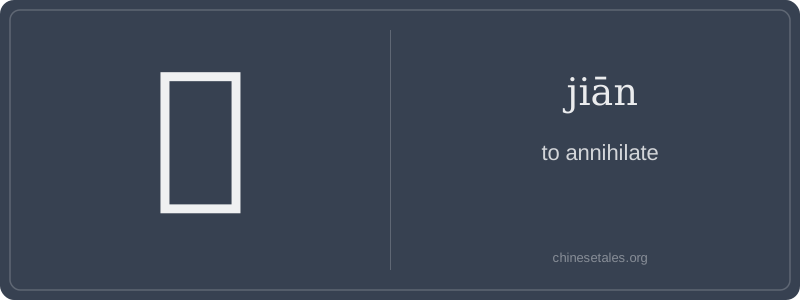
The earliest form of 歼 appears on Warring States bamboo slips as a composite character: the left side 歹 (dǎi), meaning ‘corpse’ or ‘death-related,’ originally a pictograph of a fractured skeleton; the right side 千 (qiān), ‘thousand,’ which here functions phonetically *and* semantically — suggesting ‘a thousand corpses,’ i.e., mass death. Over time, the bone-like strokes of 歹 sharpened into its current angular form, while 千 simplified from a complex ‘thousand’ glyph to today’s clean two-stroke shape. Crucially, the top stroke of 千 in 歼 is a *horizontal line*, not the dot found in similar characters — a subtle but vital detail.
By the Han dynasty, 歼 had crystallized its meaning of ‘complete destruction’ in texts like the *Book of Rites*, where it described the ritual annihilation of traitors — not just execution, but erasure of lineage and name. Its visual logic is brutally elegant: ‘death’ + ‘thousand’ = death at scale, beyond individual loss. Even today, when China’s PLA announces ‘歼敌XX人’ (jiān dí XX rén, ‘annihilated XX enemy troops’), they invoke this ancient, unflinching standard of total, irreversible victory.
Think of 歼 (jiān) as Chinese military slang’s ‘delete key’ — not just ‘kill,’ but *total erasure*: no survivors, no traces, no undo button. It’s the word used when an army wipes out an entire enemy unit, or a virus is completely eradicated from a region. Unlike generic verbs like 杀 (shā, ‘to kill’) or 消灭 (xiāo miè, ‘to eliminate’), 歼 carries visceral finality — like ‘annihilate’ in Star Trek’s ‘Resistance is futile’ speech, or the biblical ‘blot out from under heaven.’
Grammatically, 歼 is almost always transitive and formal — it demands a direct object (e.g., 歼灭敌人, jiān miè dí rén, ‘annihilate the enemy’) and rarely appears alone. You won’t hear it in daily chat; it’s reserved for historical accounts, military reports, or solemn declarations. Learners often wrongly use it reflexively (‘we were annihilated’) — but 歼 is *active*, agent-driven: only the victor 歼s, never the vanquished.
Culturally, 歼 evokes Mao-era revolutionary rhetoric and classical warfare texts like Sun Tzu, where total victory meant eliminating the enemy’s capacity to regroup — not just body count. A common mistake? Confusing it with 煎 (jiān, ‘to pan-fry’): same sound, wildly different stakes. Remember: if you’re frying eggs, you’re 煎; if you’re erasing an army from history, you’re 歼.