毑
Character Story & Explanation
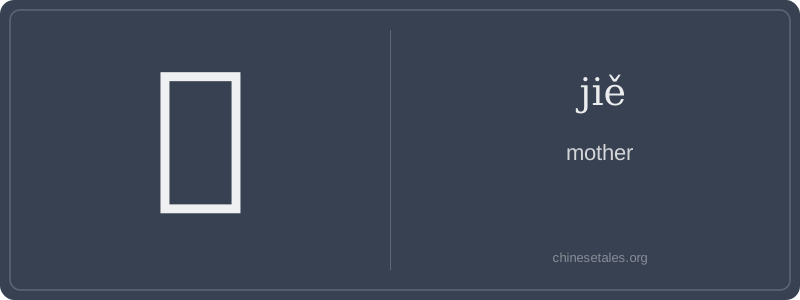
The earliest form of 毌 appears in late Shang oracle bone inscriptions as a stylized woman seated inside a bounded enclosure—often drawn with arms crossed and a pronounced pelvic curve, enclosed by a rectangular or oval frame representing the womb, household, or ritual space. Over centuries, the figure simplified: limbs became abstract strokes, the frame hardened into the outer ‘冂’-like structure, and the central element evolved from a full-bodied glyph into the ‘厶’ (sī) shape—a phonetic clue hinting at its original pronunciation *sǐ* or *xiě*. By the Qin small seal script, it had crystallized into the balanced, symmetrical form we see today: a clear container holding a subtle, closed shape.
This visual containment is no accident—it reflects the early Zhou concept of motherhood as both generative and structuring: the source of life *and* the first moral boundary. Unlike 母 (mǔ), which emphasizes nurturing function, 毌 stresses ontological priority—the mother as origin-point, the ‘root vessel’. It appears sparingly in pre-Qin bronze inscriptions (e.g., on ancestral wine vessels) and once in the *Shuōwén Jiězì* (100 CE), where Xu Shen defines it as ‘the beginning of human life’ (人所生也). Its near-total disappearance after the Han signals a semantic narrowing: society kept honoring mothers—but shifted emphasis from cosmic origin to relational care.
Imagine stepping into a quiet Song dynasty study where a scholar gently traces the character 毌 on rice paper—not to write 'mother' in daily speech, but to inscribe reverence in a memorial tablet. This isn’t the word you’d use when calling out ‘Māma!’ at dinner; 毌 is the ancient, ceremonial heart of motherhood—dignified, ancestral, almost sacred. It carries the weight of filial piety as a moral force, not just a family role. Its meaning isn’t warmth or familiarity, but origin, authority, and unbroken lineage.
Grammatically, 毌 appears almost exclusively in classical compounds or literary allusions—it’s never used alone in modern speech or writing. You won’t find it in textbooks or HSK lists because it’s functionally obsolete outside historical texts, epigraphy, or scholarly reconstructions. Trying to substitute it for 妈 (mā) or 母 (mǔ) will sound like quoting Confucius at a coffee shop: technically correct, utterly out of place. Even native speakers often misread it as 母 due to visual similarity—and that confusion is *exactly* why learners must treat it as a relic, not a replacement.
Culturally, 毌 reveals how Chinese writing preserves layers of meaning like geological strata: its form fossilizes an early Bronze Age conception of motherhood as both life-giver and boundary-setter (note the enclosing frame). Learners’ biggest mistake? Assuming archaic = interchangeable. In fact, using 毌 instead of 母 in a modern sentence doesn’t just sound odd—it subtly erases millennia of linguistic evolution and social change.