毚
Character Story & Explanation
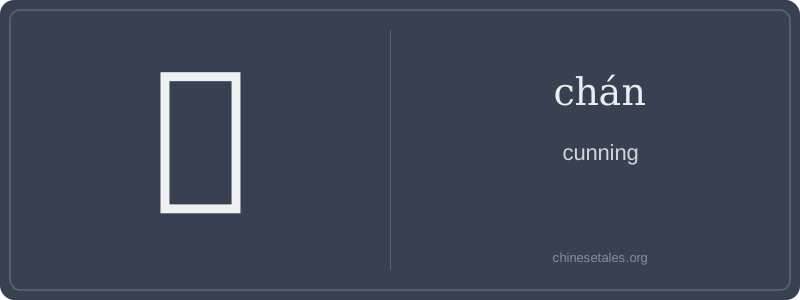
The earliest form of 毚 appears in bronze inscriptions as a vivid compound: on the left, a simplified 'rabbit' (兔, tù) — originally drawn with long ears and a curled tail — and on the right, the 'compare/compete' radical 比 (bǐ), which in oracle bone script looked like two people facing each other, arms bent in rivalry. So literally: 'a rabbit competing' — but not in speed! Ancient observers noted rabbits don’t fight head-on; they dart, feint, double-back, and vanish into brush — behavior the Zhou scribes encoded as *strategic evasion*, then abstracted into 'mental agility with intent to deceive'. Over centuries, the rabbit glyph morphed: its legs became the top strokes (⺈ + 一 + 丿), its body fused with the right-side 比, and the whole character condensed into today’s 17-stroke elegance.
This visual metaphor stuck. In the Zuo Zhuan, 毚 appears in descriptions of ministers who 'win by outmaneuvering, not overpowering' — their brilliance inseparable from moral ambiguity. By the Tang dynasty, poets like Du Fu used 毚 in compound metaphors (e.g., 毚云 — 'cunning clouds') to describe shifting, unreliable omens. Crucially, the character never meant 'clever' neutrally — its semantic core has always been *intelligence deployed against trust*. Even today, its shape — that sharp, angular 'rabbit' perched atop 'comparison' — visually echoes the idea of one mind sizing up another, calculating advantage before the first word is spoken.
At first glance, 毚 (chán) feels like a linguistic ghost — rare in modern speech but potent in classical flavor. Its core meaning is 'cunning', but not the cartoonish trickster kind: think subtle, strategic, even dangerous intelligence — the kind that plots behind silk curtains or whispers half-truths in court. It’s almost always used as an adjective modifying nouns (e.g., 毚谋 — 'cunning scheme'), and it carries strong negative moral weight, echoing Confucian disdain for guile over virtue.
Grammatically, 毚 rarely stands alone; it’s nearly always paired — especially in literary or formal registers — with words like 谋 (móu, 'scheme'), 计 (jì, 'plan'), or 心 (xīn, 'heart/mind'). You’ll almost never hear '他很毚' — that would sound archaic or jarringly poetic. Instead, it appears in set phrases like 毚言 (chán yán, 'slanderous words') or 毚计 (chán jì, 'deceitful stratagem'), often in historical novels or political commentary. Learners sometimes misread it as chǎn (like 谗), but the tone is firmly second — chán — and confusing it with 谗 (also meaning 'slanderous') is a classic pitfall we’ll address below.
Culturally, 毚 evokes pre-Qin and Han dynasty texts where moral clarity was paramount — cunning wasn’t cleverness; it was ethical corrosion. Modern usage is mostly rhetorical or ironic: a journalist might call a lobbyist’s argument 毚辞 ('cunning rhetoric') to imply manipulative logic disguised as reason. Don’t try to drop this in casual chat — it’s like quoting Machiavelli at a coffee run. Its rarity makes it a marker of high-register literacy, not daily fluency.