毷
Character Story & Explanation
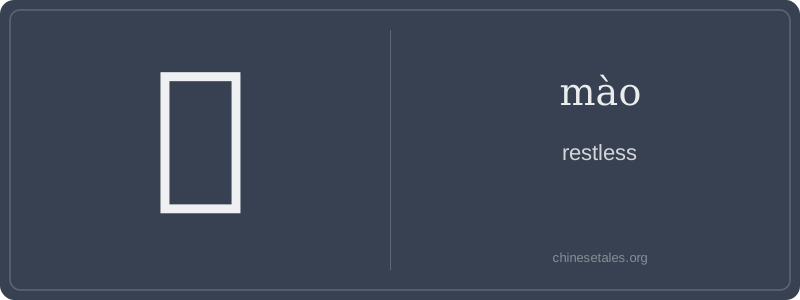
The earliest trace of 毷 appears not in oracle bones but in late Tang dynasty steles and Song dynasty dictionaries — it’s a relatively young ‘invented’ character, crafted by scholars to fill a lexical gap. Visually, it’s a brilliant mashup: the top is 毛 (máo, ‘hair’), evoking fine, twitching filaments — the kind that stand up when you’re on edge; the bottom is 散 (sàn, ‘to scatter, disperse’), suggesting unraveled composure. Stroke-by-stroke, it builds tension: first the delicate ‘hairs’, then the explosive downward sweep of 散’s right component — like nerves fraying into chaos. No ancient pictograph exists; this is calligraphy as psychology, designed to look *unstable*.
Its meaning crystallized in literary contexts: in the Ming novel Jin Ping Mei, 毷氉 describes the protagonist’s agitated pacing before a scandal breaks; in Qing poetry, it’s paired with wind or smoke to evoke restless, shape-shifting anxiety. The character doesn’t depict motion — it depicts *the feeling before motion*, the charged stillness of coiled energy. Even today, its visual asymmetry (lopsided, top-heavy, with 散’s sprawling lower half) mirrors its semantic core: equilibrium lost, composure scattered — not broken, but *twitching*.
Let’s cut through the noise: 毷 (mào) isn’t just ‘restless’ — it’s the visceral, almost physical itch of impatience, the jittery energy before a storm or an exam, the kind that makes you tap your foot and rearrange your pens *twice*. It’s deeply embodied: think sweaty palms, shallow breath, that low hum in your chest when you’re waiting for life-altering news. Unlike generic synonyms like 焦急 (jiāojí) or 不安 (bù’ān), 毷 carries literary weight and rhythmic tension — it’s rarely used alone in speech but shines in compound words and poetic or descriptive writing.
Grammatically, 毷 almost never stands solo as a predicate adjective (you wouldn’t say *‘他很毷’*). Instead, it appears almost exclusively in fixed, classical-style compounds — mostly four-character idioms (chengyu) or literary binomes like 毷氉 (mào sào), where it pairs with another character to intensify the sense of inner turmoil. Its tone (mào, fourth tone) is sharp and descending — mirroring the sinking feeling of restlessness. Learners often misread it as mào (like 冒) or confuse its structure, but crucially: it’s *not* used in modern spoken Mandarin without its partner — trying to use it bare is like quoting Shakespeare mid-sentence at a coffee shop: technically correct, culturally jarring.
Culturally, 毷 is a ‘ghost character’ — rare in daily life but vivid in classical poetry and Ming-Qing fiction, where it paints psychological states with tactile precision. A common mistake? Assuming it’s interchangeable with 烦 (fán, ‘annoyed’) — but 烦 is surface-level irritation; 毷 is deep-wired, physiological unease. Also, don’t be fooled by its radical (毛): this isn’t about hair — it’s a phonetic-semantic hybrid where 毛 hints at sound (máo → mào) while contributing texture — like the ‘fuzz’ of nervous energy.