毽
Character Story & Explanation
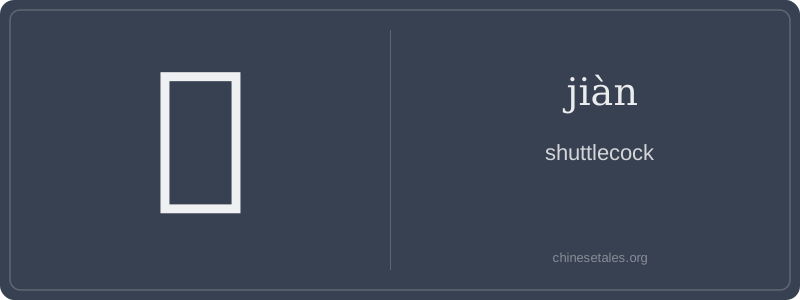
The earliest trace of 毽 appears not in oracle bones but in Han dynasty bronze inscriptions and early clerical script, where it emerged as a semantic-phonetic compound. Visually, it’s a masterclass in functional design: the top 毛 (13 strokes originally, simplified to 4) clearly depicts tufts of hair or feathers — think of three upward-curving strokes mimicking plumes. Below sits 建 (jiàn), borrowed purely for sound (it means 'to build' or 'to establish'), but its components tell a story too: the top 廴 (yǐn) suggests movement forward, and 聿 (yù) is an ancient pictograph of a hand holding a brush — together implying 'constructive action'. Over centuries, the form tightened: 毛’s curves softened, 建’s lower part (聿) lost its inner stroke, and the whole character settled into its current 12-stroke balance.
This visual marriage wasn’t accidental. In the Han dynasty, jianzi evolved from military training drills into a refined pastime — literally 'building' skill, grace, and coordination. The character 毽 thus crystallized the idea of *crafted flight*: feathers (毛) given purpose and direction through human intention (建). By the Tang and Song dynasties, poets like Su Shi referenced jianzi play in verses celebrating agility and spontaneity — and the character itself became inseparable from that cultural rhythm. Even today, seeing 毽 on a playground sign instantly conjures the soft *shush* of feathers cutting air and the cheerful shout of 'Jiànzi!' as it arcs skyward.
At first glance, 毽 (jiàn) feels like a charmingly specific word — it means 'shuttlecock', that feathered projectile used in the ancient Chinese game of jianzi, where players keep it aloft using only their feet, knees, and head. The character isn’t abstract or philosophical; it’s tactile and kinetic — evoking fluff, flight, and playful precision. Its core identity is rooted in materiality: the radical 毛 (máo, 'feather/hair') dominates the top, instantly signaling something soft, light, and filamentous — no surprise, since traditional shuttlecocks were made from goose or pheasant feathers glued to a weighted base.
Grammatically, 毽 is almost always a noun — you’ll rarely see it as a verb or modifier on its own. It appears in compounds (like 毽子) far more often than solo, and even then, it’s usually preceded by measure words: 一个毽子 (yī gè jiànzi), not *一个毽. Learners sometimes mistakenly treat it like a verb ('to shuttlecock!'), but no — it’s strictly nominal. Also, don’t confuse it with 羽 (yǔ, 'feather') or 球 (qiú, 'ball'): 毽 is neither generic nor spherical — it’s aerodynamically distinct, with a heavy bottom and light top.
Culturally, 毽 carries quiet pride — jianzi has been played for over 2,000 years, appearing in Song dynasty paintings and Ming-era poetry. Yet modern learners rarely encounter 毽 outside niche contexts: physical education classes, folk festivals, or nostalgic grandparents showing off footwork. A common mistake? Skipping the mandatory 子 suffix — saying *踢毽 instead of 踢毽子 (tī jiànzi). While colloquially tolerated, omitting 子 sounds clipped and unnatural, like saying 'kick shuttle' instead of 'kick a shuttlecock' in English.