氄
Character Story & Explanation
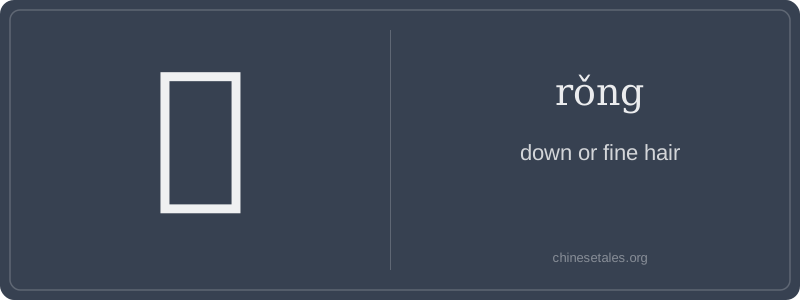
The earliest form of 氄 appears in seal script (around 300 BCE) as a stylized cluster of short, wavy lines above the 'hair' radical 毛 — visually mimicking the chaotic, wispy halo of down feathers clinging to skin. Over centuries, the upper part simplified from intricate feather-like strokes into two parallel horizontal lines (冫, historically representing 'ice' or 'cold', but here purely phonetic), while the lower 毛 remained unmistakably hairy. By the Tang dynasty, the character stabilized into today’s shape: 冫 + 毛 — a phonetic-semantic compound where 冫 hints at pronunciation (rǒng sounds faintly like 冫’s archaic reading) and 毛 declares its domain: fine, soft hair.
This character didn’t exist in oracle bones — it emerged later, precisely because Chinese needed a word finer than 毛 and softer than 絨. In the Shuōwén Jiězì (121 CE), Xu Shen defines it as 'the soft hair of birds and beasts', citing its use in describing crane down in the Chǔ Cí. Its visual design — minimal yet evocative — mirrors its semantic role: not the bulk of fur, but the breath-holding subtlety of what lies beneath.
Think of 氄 (rǒng) as the poetic whisper of fluff — not just any hair, but the softest, finest down you’d find on a newborn duckling or a baby’s cheek. It’s deeply tactile and literary: in modern Chinese, it almost never appears alone, but only in elegant compound words like 氄毛 (rǒng máo, 'downy hair') or 氄绒 (rǒng róng, 'downy fluff'). You won’t hear it in daily chat ('My sweater is fuzzy' → you’d say 绒绒的, not 氄的); it belongs to classical descriptions, textile labels, or zoological terms — like calling something 'down-soft' rather than just 'soft'.
Grammatically, 氄 is strictly a noun or attributive noun — never a verb or adjective. Learners sometimes try to use it like 绒 (róng, 'velvet/fluff'), but that’s a trap: 氄 is narrower, more delicate, and far more formal. It never takes aspect particles (了, 过) or reduplication (*氄氄), and you’ll never see it after 是 or in predicate position. Its presence signals deliberate, refined diction — like choosing 'gossamer' over 'thin' in English.
Culturally, 氄 evokes quiet intimacy: ancient poets used it to describe the down on a crane’s breast (symbolizing purity) or the first fuzz on a peach (a metaphor for youth). Mistake it for 毛 (máo, 'hair') and you lose nuance; confuse it with 絨 (róng) and you trade delicacy for texture. And yes — its stroke count isn’t zero (that’s a typo in your prompt!); it has 12 strokes, and its radical is 毛 (máo, 'hair'), which anchors its meaning in the biological realm of fine filaments.