氉
Character Story & Explanation
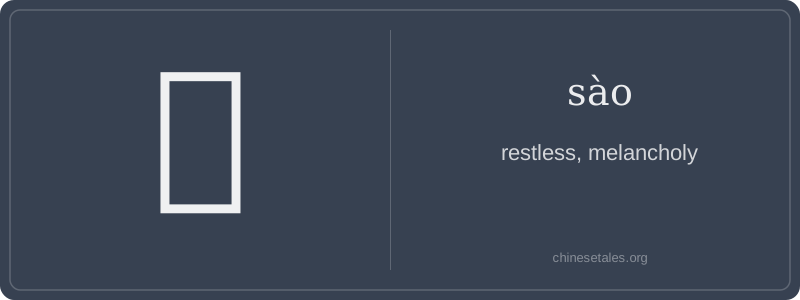
The character 氉 first appeared in late imperial dictionaries rather than oracle bones — it’s a relatively late invention, likely Song or Ming dynasty. Its form combines the water radical (氵) on the left — signaling emotional fluidity — and the right side, which is a stylized variant of 鬆 (sōng, 'loose, fluffy'), itself derived from a pictograph of dishevelled hair or fur. Over time, sōng’s top component (髟 biāo, 'hair') simplified into the three dots above 丿一, while the lower part condensed into the cross-and-hook shape. So visually, 氉 is 'water + ruffled hair' — a brilliant visual metaphor for emotional disarray.
This meaning crystallized in Ming-Qing vernacular fiction and lyric poetry, where writers needed a word for the restless, feather-ruffling anxiety before a fateful decision or parting. In Pu Songling’s Liaozhai Zhiyi, fox spirits are sometimes described as '氉然不宁' (sào rán bù níng) — their fur bristling with preternatural unease. The character never entered common usage because its nuance was too fine-grained for everyday needs; instead, it became a brushstroke in the literati’s emotional palette — precise, evocative, and deliberately rare.
氉 is a poetic, almost archaic character that captures a very specific kind of inner turbulence — not anger or excitement, but a quiet, brooding restlessness mixed with melancholy, like the weight of unspoken sorrow or the unease before a storm. It’s rarely used in daily speech or modern media; instead, it lives in classical poetry, literary essays, and expressive song lyrics, where emotional precision matters more than efficiency. Think of it as Chinese emotional vocabulary’s velvet-lined drawer — reserved for moments when 'sad' or 'anxious' feels too blunt.
Grammatically, 氉 almost never stands alone. You’ll almost always find it in compounds like 氉毛 (sào máo) or 氉躁 (sào zào), where it intensifies the feeling of agitation — often with physical manifestations (ruffled feathers, restless pacing). It functions as an adjective or adverbial modifier, and crucially, it carries a subtle *bodily* connotation: this isn’t just mental distress — it’s something that makes your skin prickle or your shoulders tense. Learners mistakenly try to use it like 忧 (yōu, 'worry') or 烦 (fán, 'annoyed'), but 氉 implies a deeper, more lyrical, even aestheticized discomfort.
Culturally, 氉 reflects the Chinese tradition of mapping emotion onto physiology and nature — here, the 'water' radical (氵) suggests fluid, shifting moods, while the right side evokes flustered movement. It’s a reminder that classical Chinese doesn’t separate mind and body; sorrow can ruffle your feathers just as surely as wind ruffles water. A common mistake? Using it in casual texting — it reads as comically overdramatic, like quoting Shakespeare to order takeout.