氘
Character Story & Explanation
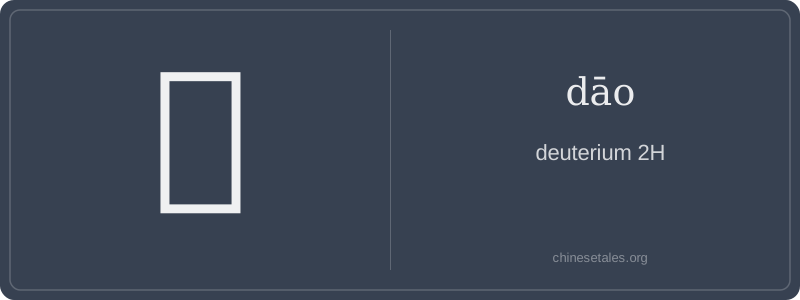
The character 氘 has no oracle bone or bronze script ancestry — it didn’t exist before the 20th century. Its creation was a deliberate act of linguistic engineering: scholars needed a single-character representation for the newly discovered isotope ‘deuterium’. They selected the existing character 刀 (dāo, ‘knife’) for its pronunciation and added the ‘gas’ radical 气 on top — not as a semantic modifier from antiquity, but as a transparent, modern categorizer. Visually, the six strokes break down cleanly: three horizontal strokes forming the top of 气 (the ‘cloud’ component), then a dot and two short lines descending — all designed for clarity under microscopes and in journal typesetting, not calligraphic flourish.
Unlike characters that evolved organically over millennia, 氘’s meaning froze the moment it was standardized in the 1934 *Chemical Nomenclature of the Republic of China*. There are zero classical references — no Confucian text, Tang poem, or Ming novel mentions it. Its entire semantic life is tied to the atomic age: from early heavy-water experiments in Shanghai labs to today’s ITER fusion project documentation. The visual pairing of 气 + 刀 is ironic — a ‘gas’ that cuts through atomic models, a ‘knife’ that slices open the nucleus. Its form doesn’t depict nature; it diagrams a conceptual need — a silent testament to how Chinese adapts, without compromise, to the frontiers of human knowledge.
At first glance, 氘 (dāo) looks like a scientific intruder in the Chinese character family — and it is! It’s a modern coinage (1930s), not an ancient glyph, created specifically to represent deuterium, the stable hydrogen isotope with one proton and one neutron. The character deliberately combines the ‘gas’ radical 气 (qì) — signaling its elemental, gaseous nature — with 刀 (dāo, ‘knife’), chosen purely for its sound (homophone with the ‘-dāo’ in deu-ter-i-um’s Chinese transliteration 德特里乌姆 → dāo). So while 气 hints at physical state, 刀 contributes zero semantic meaning — it’s pure phonetic scaffolding. This makes 氘 a rare ‘phonetic loan character’ born from nuclear physics, not philosophy or poetry.
Grammatically, 氘 functions exclusively as a noun — never a verb or adjective — and almost always appears in compound terms (e.g., 氘核, 氘气). You’ll never say ‘I have 氘’ alone; it’s always embedded: ‘氘含量’ (deuterium content), ‘富氘水’ (deuterium-enriched water). Learners often mistakenly treat it like a common noun and try to pluralize it or add measure words (e.g., *一氘*), but it’s uncountable and requires classifiers only in technical contexts (e.g., 一克氘 — ‘one gram of deuterium’).
Culturally, 氘 carries no idioms, proverbs, or literary weight — it’s strictly lab-coat vocabulary. Its ‘quirk’ is its humility: despite powering fusion research and heavy-water reactors, it remains invisible outside science textbooks and nuclear glossaries. A common learner trap? Misreading it as 刀 (knife) or 气 (qi/gas) alone — forgetting that here, 气 isn’t ‘vital energy’, and 刀 isn’t sharp — they’re just collaborators in a very precise, very quiet scientific code.