氝
Character Story & Explanation
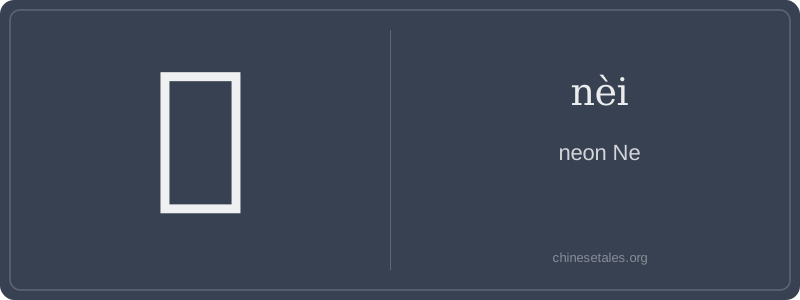
The character 氝 has no oracle bone or bronze script ancestry — it didn’t exist before 1919. It was invented during China’s New Culture Movement, when scientists and linguists collaborated to standardize chemical nomenclature. The designers chose the water radical 氵 (three dots of water) — already used for gaseous elements (oxygen, nitrogen, chlorine) — because at room temperature, many such elements were stored or handled in liquefied form under pressure. To the right, they placed 内 (nèi), not for its meaning ‘inside’, but primarily as a *phonetic component*, since ‘neon’ approximates ‘nèi’ in Mandarin. Visually, it evolved directly from this deliberate fusion: three water dots + 内 — no simplification, no historical variant. Its strokes weren’t carved or cast; they were drafted on paper in a Peking University lab.
Its meaning never shifted — it was born singular and stayed so: the element neon. Unlike characters such as 道 (dào), which grew from ‘road’ to ‘principle’ to ‘Tao’, 氝 has no classical literary presence. You won’t find it in the *Shijing* or *Zhuangzi*. Its ‘cultural life’ began under electric signage in Shanghai’s 1930s Bund — where neon signs (霓虹灯) glowed, though notably, those used 霓 (ní) and 虹 (hóng), not 氝. That irony remains: 氝 names the gas, yet the iconic ‘neon lights’ are called 霓虹灯 — a poetic, non-scientific term that sidelined the technical character entirely.
Let’s cut to the chase: 氝 (nèi) isn’t a character you’ll encounter in everyday conversation — or even in most chemistry textbooks written for Chinese learners. It’s a modern scientific loan character, coined in the early 20th century to represent the chemical element neon (Ne). Unlike ancient characters rooted in nature or human action, 氝 was deliberately engineered: the left radical 氵 (water radical) signals it’s a *liquid/gaseous element* (a convention used for many nonmetals like 氧 ‘oxygen’ and 氮 ‘nitrogen’), while the right component 内 (nèi, ‘inside’) provides both sound and conceptual resonance — neon lights ‘hold light inside’ glass tubes, glowing from within. Its feel is cool, precise, and slightly clinical.
Grammatically, 氝 functions only as a noun — never as a verb, adjective, or measure word. You’ll see it almost exclusively in compound terms like 氝灯 (neon lamp) or in scientific contexts: ‘This sign uses 氝.’ NOT ‘The gas is very 氝.’ Learners sometimes mistakenly try to use it adjectivally (e.g., *氖色*), but native speakers say 氖红色 (neon-red) or just ‘neon color’ borrowed as 霓虹色. No standalone verbs, no reduplication, no aspect particles — it’s a lexical island.
Culturally, 氝 is a quiet testament to how Chinese absorbs Western science: not by transliterating ‘neon’ syllable-by-syllable (like ‘ni-ē-ōn’), but by crafting a character that *feels* Chinese — using existing radicals and phonetic logic. A common mistake? Confusing it with 内 (nèi, ‘inside’) due to identical pronunciation and shared right component — but 氝 has 氵; omit it, and you’ve switched from noble gas to interior space!