氠
Character Story & Explanation
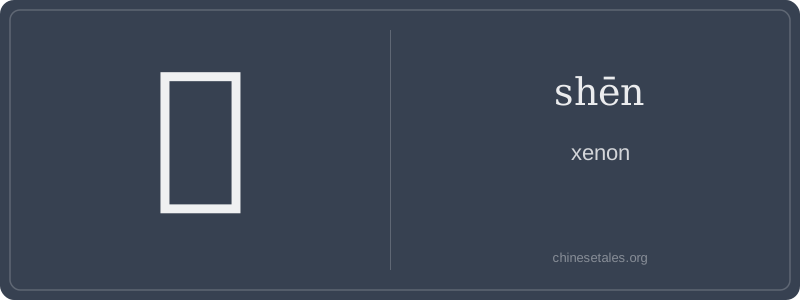
The character 氫 didn’t exist before the 20th century—it’s a modern coinage, born from the urgent need to translate Western chemical nomenclature. Its form is a deliberate hybrid: left side 氵 (the ‘water’ radical, repurposed here to signal ‘liquid/gaseous element’—a convention borrowed from Japanese kanji adaptations), right side 申 (shēn), both for sound *and* symbolic weight. 申 originally depicted lightning zigzagging across oracle bones—a sign of divine authority and revelation. That ancient spark now electrifies this character’s identity: xenon, after all, lights up when zapped with current.
When chemists in Republican-era China formalized the periodic table in Mandarin (1930s), they assigned 申 to xenon not just for phonetic fit but for conceptual resonance: 申 means ‘to declare’, ‘to extend’, ‘to manifest’—perfect for an element that remains invisible until energized, then blazes forth in brilliant blue-white light. No classical text mentions 氫 (it’s absent from the Shuōwén Jiězì), yet its design is deeply classical in logic: combining semantic hint (氵 for elemental state) and phonosemantic force (申 as both sound anchor and metaphor for activation).
Think of 氠 (shēn) as Chinese chemistry’s version of a sci-fi movie prop: it’s not something you’ll bump into at the market or in a love letter—it’s a lab-only VIP, reserved for neon signs, deep-space propulsion, and medical imaging. Unlike common elements like 氧 (oxygen) or 碳 (carbon), 氫 doesn’t appear in daily vocabulary; it’s strictly technical, almost ceremonial—used only when precision matters, and never in isolation (you’ll always see it in compounds like 氪气 or 氪灯).
Grammatically, 氫 behaves like a noun with zero flexibility: no measure words, no reduplication, no aspect particles. You won’t say ‘氫了’ or ‘很氫’. It only appears after classifiers like 种 (a kind of) or in fixed phrases with 气 (gas), 灯 (lamp), or 射线 (radiation). Example: ‘这种稀有气体是氫’ — note how it’s introduced by 是…的 structure, never used predicatively alone.
Culturally, learners often misread 氫 as a ‘common’ character because of its simple appearance—but its radical 氵 (water) is a red herring: xenon isn’t wet, nor reactive like water-related characters. This mismatch trips people up. Also, many confuse it with 氦 (helium) or 氖 (neon)—all ending in -en sounds and sharing the gas radical. The key? 氫 is the heaviest of the noble gases used in China’s high-tech applications—and the only one whose name was deliberately chosen to echo ‘shēn’, sounding like ‘shen’ in ‘shenmi’ (mysterious), nodding to its elusive, inert nature.