氥
Character Story & Explanation
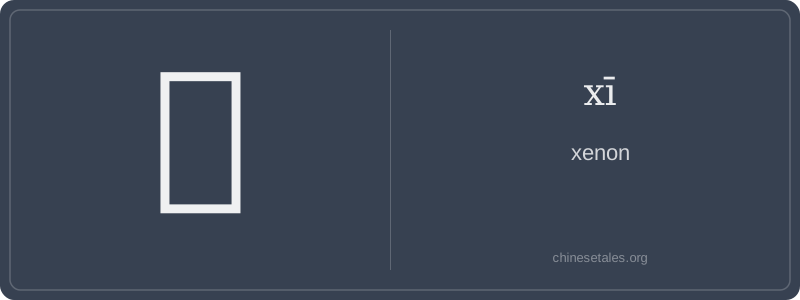
氫 has no oracle bone or bronze script ancestry — it didn’t exist before 1933. When Chinese chemists standardized chemical nomenclature, they faced a challenge: how to render ‘xenon’? They chose the phonetic component 希 (xī), already meaning ‘rare’ — a brilliant double-meaning nod to xenon’s extreme scarcity in Earth’s atmosphere (0.087 ppm). To this, they added the ‘water’ radical 氵 on the left, signaling it’s a nonmetallic element, consistent with other gases like 氧 (oxygen) and 氮 (nitrogen). The result: a deliberately constructed, rational, non-historical character — all 10 strokes assembled with engineering precision, not poetic evolution.
This radical-phonetic design reflects a watershed moment in Chinese linguistic history: the systematic creation of characters for modern science. Unlike ancient characters whose meanings grew organically over millennia, 氫’s meaning was fixed at birth — strictly chemical, strictly literal. There are no classical texts referencing it; no Tang poems whisper its name. Its ‘history’ is one of deliberate standardization: adopted by the Committee on Scientific Terminology in 1933, cemented in textbooks by the 1950s, and now universally recognized — a silent testament to language as a tool for global knowledge, not just cultural memory.
Imagine you’re in a high-tech lab in Shanghai, watching a physicist seal a tiny glass tube filled with a faint blue glow — that’s 氣 (qì) meets ‘xenon’… but wait — it’s not 氣. It’s 氥 (xī), the ultra-rare noble gas element, and its name is a masterclass in modern Chinese scientific translation: borrowed sound + semantic radical. Unlike native Chinese characters with deep cultural roots, 氫 is a 20th-century invention — no classical usage, no idioms, no poetry. It exists solely as a precise label in chemistry textbooks, lab reports, and periodic tables.
Grammatically, 氫 behaves like any elemental noun: it never stands alone in speech (you won’t say ‘I drank 氫’), but always appears in compounds (e.g., 氫氣 xī qì ‘hydrogen gas’) or with measure words like ‘克’ (gram) or ‘升’ (liter). Crucially, it’s *never* used metaphorically — unlike 氣 (qì), which means ‘vital energy’ or ‘atmosphere’, 氫 carries zero philosophical baggage. Learners sometimes misread it as 氣 or 氧 (yǎng, oxygen), leading to hilarious (and dangerous) mix-ups in technical contexts.
Culturally, 氫 embodies China’s pragmatic approach to scientific neologisms: adopt the Western pronunciation (‘xi’ from ‘xenon’), graft it onto the water/liquid radical 氵 (to signal it’s a nonmetallic *element*, often gaseous or liquid at room temp), and voilà — a character born of necessity, not tradition. Its absence from HSK reflects reality: unless you’re studying chemistry or reading Chinese physics journals, you’ll likely never encounter it — and that’s perfectly fine.