氨
Character Story & Explanation
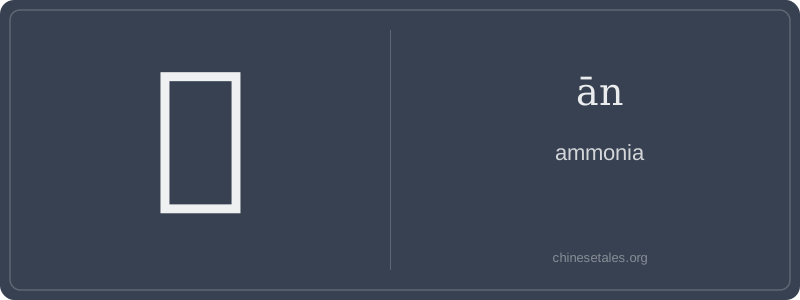
The character 氨 didn’t exist in ancient China — it has no oracle bone or bronze script form. It was created around 1870 by Qing dynasty scholars collaborating with Western missionaries and chemists, using the newly standardized chemical nomenclature system. Its structure is brilliantly logical: top radical 气 (qì, 'vapor' or 'gas') signals its physical state, while the bottom component 安 (ān, 'peace', 'calm') was chosen *solely* for its sound — matching the first syllable of 'am-mo-ni-a'. Visually, the 10 strokes break down as: 气 (4 strokes: 丿、一、丿、丶) + 安 (6 strokes: 宀 + 女). The roof-like 宀 shelters the 'woman' (女), evoking stability — an ironic visual metaphor for a volatile, pungent gas that smells like sharp urine and can burn your throat.
This character is a rare 'phonosemantic neologism' — one of only ~200 modern Chinese characters invented for chemistry. Unlike classical characters whose meanings evolved organically, 氨’s semantics were locked at birth: it *means* NH₃ and nothing else. No classical text mentions it — the earliest recorded use appears in 1871’s 《化学鉴原》 (*A Primer of Chemistry*), where translator Xu Shou explicitly states he selected 安 for pronunciation, not meaning. So while 安 usually suggests safety, here it’s just a phonetic placeholder — a brilliant linguistic hack that turned 'am-' into ān, making ammonia instantly pronounceable for Mandarin speakers without distorting the language’s writing system.
Think of 氨 (ān) as Chinese chemistry’s version of a stealthy French loanword — it doesn’t *feel* Chinese at all, and that’s the point. Unlike native characters with poetic or agricultural roots, 氨 was deliberately invented in the late 19th century to transliterate the English word 'ammonia' (from Latin *sal ammoniac*, named after the Temple of Amun in Libya). Its meaning is purely scientific and unambiguous: it refers *only* to the compound NH₃ — no metaphorical extensions, no idioms, no emotional baggage. You’ll never see it in poetry or proverbs; it lives exclusively in lab reports, fertilizer labels, and environmental regulations.
Grammatically, 氨 behaves like a noun — always uncountable, never pluralized, and almost never used alone. It nearly always appears in compounds (like 氨水 or 氨气) or with measure words like '份' (fèn, 'portion') or '克' (kè, 'gram'). Crucially, it’s *not* a verb or adjective — so you’d never say '这个溶液很氨' (❌); instead, you’d say '这个溶液含有氨' ('this solution contains ammonia'). Learners sometimes mistakenly treat it like a descriptive word, but it’s strictly referential — like saying 'DNA' in English: precise, technical, and context-bound.
Culturally, 氨 carries quiet urgency: it’s associated with both life (as a nitrogen source for crops) and danger (toxic fumes, industrial accidents). In China, public health campaigns about rural well-water contamination often feature 氨 prominently — not as abstract science, but as a real-world threat requiring literacy. A common mistake? Confusing it with 氨's lookalike 合 (hé, 'to combine') or misreading its radical 气 as 'steam' rather than 'vapor/gas' — a subtle but critical distinction, since 氨 is *always* gaseous at room temperature.