氩
Character Story & Explanation
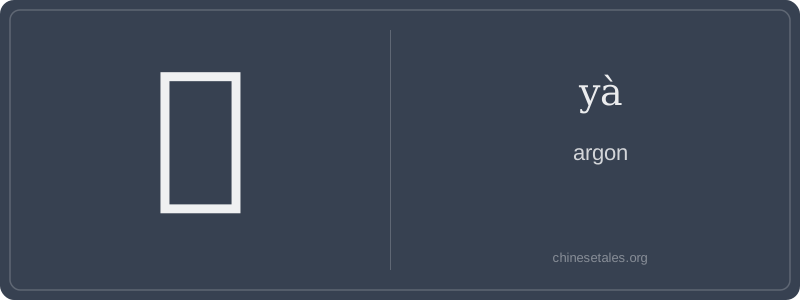
The character 氩 didn’t exist before 1919—it was crafted from scratch using classical building blocks. Its oracle bone or bronze script ancestors? None. Instead, scholars looked to tradition: they chose 气 (qì), the ancient pictograph of rising steam or breath—three wavy lines under a lid-like cover—to represent 'gas'. Below it, they placed 易, a character originally depicting a lizard shedding skin (symbolizing change), later simplified into its modern form. Here, 易 wasn’t chosen for meaning but for phonetic approximation: early Western 'argon' sounded close to 'yì', and tone adjustments (yì → yà) followed standard scientific naming conventions.
This makes 氩 a rare case of intentional, rational neologism—not evolution, but engineering. Unlike characters that drifted semantically over millennia, 氩 arrived fully formed, calibrated for precision. Classical texts never mention it, of course—but its design honors tradition: 气 roots it in Chinese cosmology (where qì is vital energy), while 易 subtly nods to transformation—even though argon famously *resists* change. That quiet irony? A tiny linguistic wink at chemistry’s poetry.
氩 (yà) isn’t ancient—it’s a 20th-century linguistic immigrant, born when Chinese scientists needed a name for the newly discovered noble gas argon in 1919. Its core meaning is purely scientific: a colorless, odorless, inert gas used in welding, lighting, and double-glazed windows. Visually, it’s a perfect example of a modern phono-semantic compound: the top radical 气 (qì, 'air' or 'gas') signals its category, while the bottom component 易 (yì, 'easy') provides the sound clue—though pronunciation shifted slightly to yà (a common tonal adaptation for foreign-element names, like 氦 hēi for helium).
Grammatically, 氩 behaves like any noun denoting a chemical element: it never takes aspect markers (了, 过), doesn’t pluralize, and almost always appears with classifiers like 种 (zhǒng, 'kind') or in compound terms (e.g., 氩气). Learners sometimes mistakenly treat it as a verb ('to argon') or add measure words like 个—big no-no! It’s strictly uncountable and requires 气 (gas) or the context to make sense: you say 氩气 (yà qì), not just 氩 alone in speech.
Culturally, 氩 is invisible yet indispensable—like many scientific loan characters, it reflects China’s rapid modernization: old radicals repurposed for new science. A frequent error? Confusing it with 易 (yì, 'easy') or 氧 (yǎng, 'oxygen') due to similar lower components. Remember: if it has 气 on top and feels like a lab manual, it’s probably an element—and 氩 is the quietest one in the periodic table.