汆
Character Story & Explanation
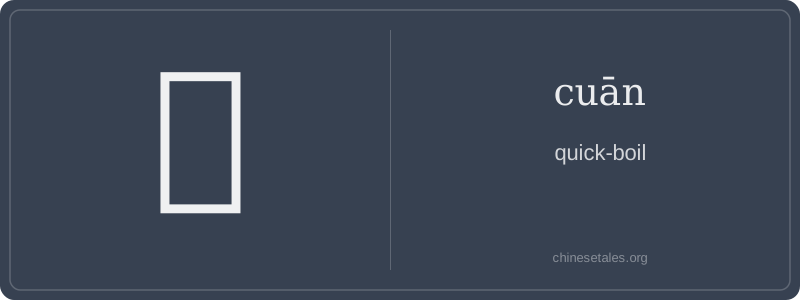
The earliest form of 汆 appears in late Warring States bronze inscriptions as a simplified pictograph: two parallel horizontal strokes (representing turbulent water surface) above a single downward stroke — like water violently churning *downward* beneath a submerged object. Over time, the top became the standard 氵 (three-dot water radical), while the bottom evolved from a simple vertical line into the modern 口 (‘mouth’ shape, though not semantic here) — likely by clerical script stylization, where quick brushstrokes merged the original ‘submerging action’ into a compact, box-like form.
This visual evolution mirrors its semantic journey: from a general idea of ‘sinking into water’ in early texts (e.g., in the *Shuōwén Jiězì*, it was glossed as ‘to sink’), it narrowed sharply during the Song and Ming dynasties into a specialized culinary term. By the Qing dynasty, cookbooks like *Suiyuan Shidan* used 汆 exclusively for rapid immersion — a shift driven by chefs needing a precise word for a technique that preserved umami and tenderness. The ‘mouth’-shaped bottom may even subtly echo the *brief opening* of a pot lid or the *instant* food disappears beneath the surface — a visual wink to its temporal precision.
Imagine you’re in a Beijing alleyway kitchen at dawn: steam hisses from a wok, but the chef isn’t stir-frying — he’s holding a bamboo skimmer over a pot of violently bubbling water. With lightning speed, he dips thin slices of beef in for *just three seconds*, pulls them out glistening and tender, and tosses them into a fragrant hotpot broth. That precise, fleeting immersion? That’s 汆 (cuān) — not boiling, not simmering, not poaching — but *quick-boiling*: a culinary verb that captures the exact moment food meets scalding water and transforms without overcooking.
Grammatically, 汆 is almost always a transitive verb used with food nouns (e.g., 汆肉片, 汆豆腐), never standalone. Learners often wrongly use it like ‘boil’ (煮) or confuse it with ‘blanch’ (焯), but 汆 implies *immediate removal* upon contact — no lingering. It’s also rarely used in speech outside cooking contexts; you won’t ‘汆’ a book or a person. And crucially: it’s written with 水 (water) radical, not 火 (fire), because the heat source is secondary — the water’s violent motion and temperature are what define the technique.
Culturally, 汆 reflects Chinese cuisine’s obsession with texture control: too long = rubbery; too short = raw. It’s essential for delicate ingredients like fish fillets, leafy greens, or tofu skin. A common mistake? Using it for soups where ingredients cook *in* the liquid — that’s 煮 or 炖. Also, watch your tone: cuān (first tone) is easy to mispronounce as cuàn (fourth tone, meaning ‘to flee’ — imagine fleeing from overcooked bok choy!).