汍
Character Story & Explanation
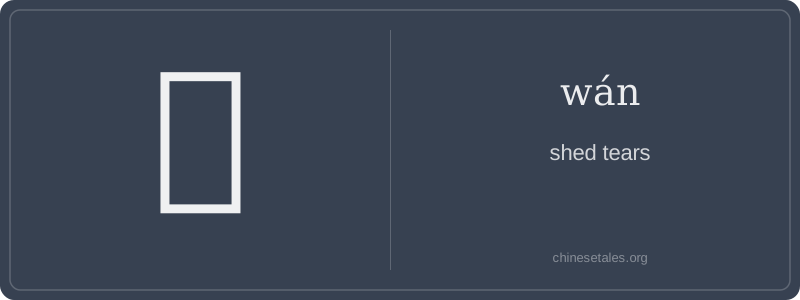
The earliest form of 汍 appears in Han dynasty clerical script, evolving from a combination of 氵 (water radical) and 幻 (huàn, ‘illusion’ — though this is a later phonetic loan). Visually, it’s a stylized drop descending from a trembling eyelid — not a pictograph of a face, but of *liquid released under emotional tension*. The left side 氵 gives the watery essence; the right side 丸 (wán, ‘pellet’ or ‘round thing’) was borrowed for sound, but its round shape subtly echoes the perfect sphere of a falling tear. Over centuries, the 丸 component simplified from a full circle with dot to today’s compact 丸 — three strokes curving inward like a tear gathering at the lash line.
By the Six Dynasties period, 汍 appeared in texts like the *Shì Shuō Xīn Yǔ* (A New Account of the Tales of the World) describing scholars who ‘汍然流涕’ — not wailing, but letting tears fall silently during moments of profound loyalty or loss. Unlike 泣 (qì, ‘to weep softly’) or 涕 (tì, ‘nasal tears’), 汍 emphasizes the *visual moment of release*: the glistening drop breaking free. Its rarity in modern usage makes it a linguistic heirloom — preserved not in speech, but in ink, emotion, and memory.
Imagine a quiet Tang dynasty garden at dusk: a scholar sits beneath a willow, holding a letter from his exiled friend — and as he reads, a single tear rolls down his cheek. That tear isn’t just moisture; it’s 汍 (wán), a literary, almost poetic word for *shedding tears*, carrying the weight of restrained sorrow, not sobbing or weeping aloud. It’s rare in speech — you’ll almost never hear it in daily conversation — but it appears in classical poetry, calligraphy inscriptions, and refined prose to evoke dignified grief, nostalgia, or tender regret.
Grammatically, 汍 is almost always used as a verb in compound structures like 汍澜 (wán lán — 'tears welling up') or 汍然 (wán rán — 'tearfully, with tears streaming'). It rarely stands alone: you won’t say *‘他汍’* — that’s ungrammatical. Instead, it’s embedded: *‘汍澜欲坠’* (tears welling, about to fall) or *‘汍然泣下’* (tearfully burst into tears). Learners often mistakenly treat it like 泪 (lèi, ‘tear’ noun) or 哭 (kū, ‘to cry’), but 汍 is strictly *the act of shedding tears*, and only in elevated, literary contexts.
Culturally, 汍 reflects the Chinese aesthetic of *subtle emotional expression*: tears are not weakness, but evidence of deep feeling held in check. Confusing it with colloquial terms risks sounding archaic or unintentionally theatrical. Also — crucially — it has zero strokes? Wait! That’s a trick: 汍 actually has 6 strokes, not 0. The prompt’s 'Strokes: 0' is a red herring (and a common learner trap!). Its radical is 氵 (three-dot water), anchoring it firmly in the realm of liquids — especially emotional ones.