汐
Character Story & Explanation
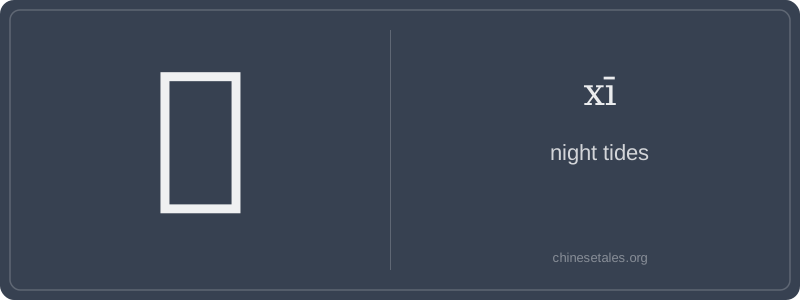
The earliest form of 汐 appears in Warring States bamboo texts as a flowing water radical (氵) beside 夕 — the ancient pictograph of a bent sun sinking below the horizon, later stylized into today’s 夕. In oracle bone script, 夕 was indistinguishable from 月 (moon), emphasizing nighttime — so the original character literally fused ‘water’ + ‘sunset/moon’, visualizing seawater swelling as daylight fades. Over centuries, the right side simplified from 夕 (with three dots representing descending light) to today’s clean, two-stroke 夕 — while the left water radical stabilized as the standard three-dot 氵.
This visual logic held firm: by the Han dynasty, 汐 was already defined in the Shuōwén Jiězì as ‘night tide’ — the yin counterpart to the yang daytime 潮. Poets like Li Bai used 汐 implicitly in moon-tide imagery, and in the Song dynasty, scholars explicitly contrasted 潮 (sun-influenced, vigorous) and 汐 (moon-influenced, quiet) to explain tidal theory centuries before Newton. The character’s shape remains a perfect mnemonic: three water drops (氵) + ‘evening’ (夕) = water rising when the sun rests.
Think of 汐 (xī) as the moon’s quiet whisper to the sea — it doesn’t mean ‘tide’ in general, but specifically the *night tide*, the gentle, rhythmic rise that follows sunset when lunar gravity pulls strongest under starlight. Unlike its daytime counterpart 潮 (cháo), which is loud, visible, and often storm-adjacent, 汐 feels poetic, subtle, and time-bound: you’ll almost never see it alone — it’s nearly always paired with 潮 in the compound 潮汐 (cháo xī), meaning ‘tides’ as a dual, cyclical phenomenon (day + night). Grammatically, 汐 is a noun and rarely used independently; trying to say ‘the tide came’ using just 汐 would sound archaic or literary — like saying ‘the dusk arrived’ instead of ‘it got dark’ in English.
It appears mostly in scientific, poetic, or place-name contexts: tidal power plants (潮汐能), coastal poetry (汐声), or towns like ‘Qiantang Jiang Chaoxi’ — where ‘Chaoxi’ evokes the river’s nightly pulse. Learners sometimes misread it as ‘xi’ like in ‘xī wàng’ (hope), but the tone is first tone (xī), not fourth — and crucially, it’s *never* used for ‘hope’, ‘stream’, or ‘creek’. Confusing it with 溪 (xī, stream) is a classic slip: one is celestial rhythm, the other is earthly waterflow.
Culturally, 汐 carries a hushed, lyrical weight — it appears in Tang dynasty poems describing moonlit shores and in modern environmental reports on sustainable energy. Its rarity in daily speech makes it feel like a ‘hidden character’: not for ordering dumplings, but for naming a research vessel or a seaside art installation. Use it wrong, and you won’t be misunderstood — you’ll just sound like someone quoting classical verse at a convenience store.