汜
Character Story & Explanation
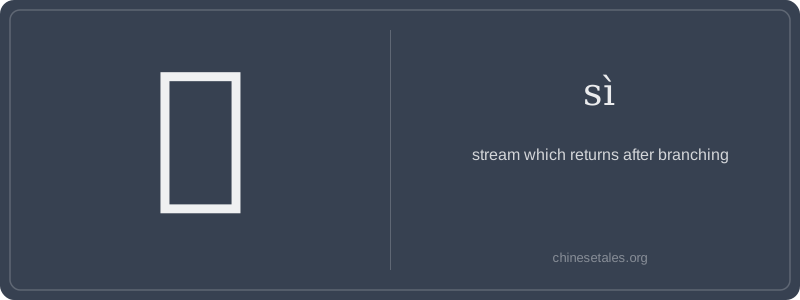
The earliest form of 汜 appears in bronze inscriptions as a flowing line (water) with a looping curve beside it — not a straight fork, but a deliberate arc suggesting a return path. Over centuries, the water element solidified into the standard three-dot radical 氵, while the right side evolved from a pictograph of a coiled serpent (巳) into a stylized '巳' — chosen not for meaning, but for sound (sì) and visual rhythm. The six strokes emerged cleanly: three for water (氵), then three for 巳 — a perfect balance of motion and containment.
This looping shape mirrors its definition: water that doesn’t abandon its origin. In the Classic of Poetry (Shījīng), 汜 appears in the famous 'Fán Bǐ Sì Shuǐ' poem — describing a woman standing by the returning branch of a river, symbolizing loyalty amid separation. Even today, 汜 waterways are studied by historians tracing ancient flood control systems — where engineers deliberately designed branches to loop back, preventing erosion. The character isn’t just descriptive; it’s a hydraulic philosophy carved in ink.
Think of 汜 (sì) not as just 'a stream', but as a *rebellious river* — one that splits off, wanders away, then loops back to rejoin its parent flow. That ‘returning after branching’ nuance is key: it’s not a dead-end tributary or a stagnant branch, but a dynamic, cyclical watercourse. In classical Chinese, 汐 was sometimes confused with 汜, but no — this character carries quiet intentionality, like a river choosing its own poetic detour before coming home.
Grammatically, 汜 is almost never used alone in modern speech — it’s a literary, place-name, or historical term. You’ll find it in ancient geography texts or in proper nouns like 汜水 (Sìshuǐ), a real river near Zhengzhou. It functions as a noun (always modified by another word, e.g., 汜水, 汜流), never as a verb or adjective. Learners often misread it as sī or shì — but the tone is sharp, falling fourth tone: sì, like saying 'see!' with finality and a splash.
Culturally, 汜 appears in the famous Shuō Wén Jiě Zì (121 CE), where Xu Shen defines it as 'a branch of water that returns to its source' — a rare hydrological concept encoded in a single character! Modern learners rarely encounter it outside classical study or place names, so don’t stress memorizing usage patterns — focus instead on recognizing its elegant water-radical + 巳 shape and appreciating how Chinese condensed an entire hydrological behavior into six strokes.