汭
Character Story & Explanation
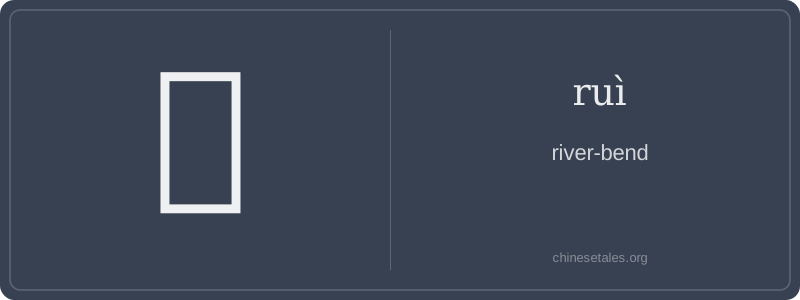
The earliest form of 汭 appears in Western Zhou bronze inscriptions as a stylized pictograph: two parallel wavy lines (representing flowing water) curving sharply around a central vertical stroke — like water wrapping around a rocky promontory. Over centuries, the wavy lines simplified into the three-dot ‘water’ radical (氵) on the left, while the right side evolved from a bent line + ‘inner’ component (內) into today’s ‘芮’, which preserves the sense of ‘turning inward’. The original oracle bone version looked less like a character and more like a topographic sketch — a cartographer’s shorthand for ‘here the river folds’.
By the Warring States period, 汭 had crystallized as a technical term in geographical treatises like the Yu Gong (Tribute of Yu), where it designated specific bends used to define feudal domains. Its meaning never broadened — unlike ‘bend’ in English, which applies to roads or elbows, 汭 remained exclusively hydrological and honorific. In the Shuō Wén Jiě Zì, Xu Shen defined it tersely as ‘the inner curve of a river’, emphasizing its spatial precision. Even today, when scholars reconstruct ancient river courses, 汭 is their linguistic GPS point — not a metaphor, but a coordinate.
Imagine standing on a high cliff overlooking the Yellow River near Tongguan — where the river makes a sharp, dramatic turn before plunging into the Loess Plateau. That exact curve, where water hesitates, swirls, and gathers force before changing direction? That’s a 汭 (ruì). It’s not just any bend — it’s a *geographically significant*, almost ceremonial river-bend: the kind that shaped ancient settlement patterns, inspired classical poetry, and marked territorial boundaries in Zhou dynasty records. In Chinese, 汭 carries quiet gravity; it’s poetic, literary, and nearly extinct in daily speech — you’ll find it in historical geography texts or Tang dynasty poems, never in subway announcements or WeChat chats.
Grammatically, 汭 functions only as a noun — always part of a proper noun or compound, never standalone in modern usage. You won’t say ‘the river bends’ using 汭; instead, you’ll see it in place names like ‘Jiāng Ruì’ (a legendary bend on the Yangtze) or paired in classical phrases like ‘河汭’ (hé ruì — ‘the bend of the river’). Learners sometimes misread it as ‘ruì’ meaning ‘auspicious’ (like 瑞), but that’s a homophone trap — no semantic link whatsoever. Also, don’t try to use it in verbs or adjectives: it resists conjugation like a stubborn stone in the current.
Culturally, 汭 evokes the ancient Chinese worldview where landforms were cosmological anchors — bends weren’t accidents of erosion but sacred thresholds. Confucius himself referenced ‘河之汭’ in ritual contexts, linking hydrology with moral order. Today, mistaking 汭 for common words like 润 or 瑞 can derail your reading of classical texts — and since it’s absent from HSK, most textbooks ignore it entirely, leaving learners unprepared for real pre-modern literature.