沁
Character Story & Explanation
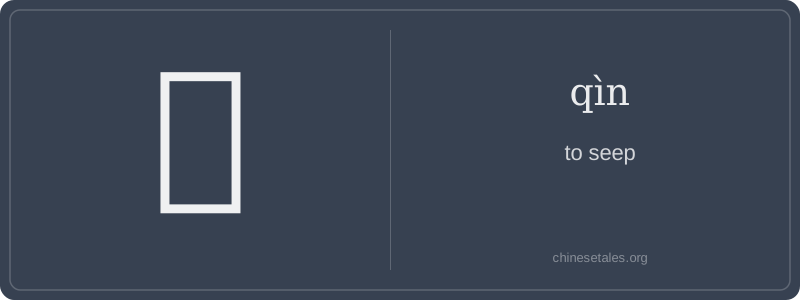
The earliest form of 沁 appears in small-seal script (c. 220 BCE), evolving from a simpler pictograph: three dots (氵) representing flowing water on the left, and 又 (yòu, ‘again’ or ‘hand’) on the right — but crucially, 又 here was not a hand, rather a stylized depiction of *water trickling down a slope*, with the ‘dots’ suggesting droplets and the lower stroke mimicking a downward path. Over time, 又 simplified into the modern ‘ten’-shaped 十, and the whole character stabilized at seven strokes: three for 氵, then 丿一丨, forming a compact, downward-flowing silhouette — visually echoing the very act of seeping.
This visual logic shaped its meaning: classical texts like the Shuōwén Jiězì (100 CE) defined it as ‘water entering deeply’ — emphasizing depth and quiet persistence. By the Tang and Song dynasties, poets used 沁 to describe sensory immersion: Li Qingzhao wrote of fragrance 沁袖 (qìn xiù, ‘seeping into sleeves’), while Su Shi evoked mountain mist 沁骨 (qìn gǔ, ‘seeping into the bones’ — i.e., chillingly penetrating). Its form — water descending — never lost that tactile, downward, intimate quality: always moving inward, always cool, always unhurried.
At its heart, 沁 (qìn) isn’t just ‘to seep’ — it’s the quiet, inevitable infiltration of something subtle and cool: dew into soil, fragrance into air, or calm into a restless mind. Unlike forceful verbs like 流 (liú, 'to flow') or 洒 (sǎ, 'to splash'), 沁 carries a gentle, almost poetic inevitability — things don’t burst in; they *permeate*, often imperceptibly at first. You’ll rarely hear it in casual speech (hence its absence from HSK), but it thrives in literary, sensory, and emotional contexts: a scent that 沁入心脾 (qìn rù xīn pí, 'seeps into heart and spleen' — i.e., deeply moves you), or moonlight that 沁凉 (qìn liáng, 'seeps-cool') the skin.
Grammatically, 沁 is almost always transitive and appears in compound verbs or set phrases — it rarely stands alone. It pairs with directional complements (e.g., 沁入, 沁出) or forms adjectives (沁凉, 沁润). Learners often mistakenly use it like a general synonym for ‘enter’ or ‘go in’ — but 沁 implies *gradual, liquid-like penetration with a sensory or emotional effect*. Saying 房间沁进水了 (fáng jiān qìn jìn shuǐ le) sounds unnatural; instead, you’d say 水渗进来了 (shuǐ shèn jìn lái le) — because 沁 emphasizes the *quality* of entry, not just the fact.
Culturally, 沁 reflects the Chinese aesthetic of understated influence — think of tea’s aroma 沁人心脾, or ink bleeding softly into rice paper. It’s the character of slow mastery, quiet absorption, and embodied feeling. A classic learner trap? Overusing it trying to sound ‘literary’, only to sound archaic or off-key. Remember: 沁 is a whisper, not a shout — and it only whispers where water, scent, coolness, or emotion dissolve boundaries.